OBITUARY
Tse-Wei & Lin-Li Chen
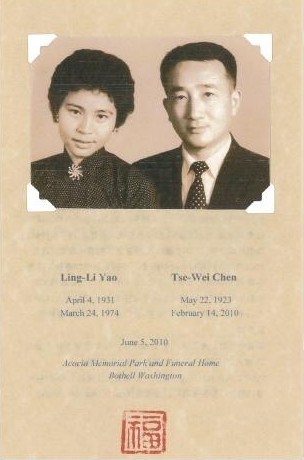
He leaves his wife, Ling-Ying Yao; his daughter, Mei Chen Chiu; her husband, Sin-Lim Chiu; his son, Paul Chen and wife, Jen Yuen; his son, Bill Chen and wife, Sharan Chang; his brothers, Wen Shuh, Wen Yih, Wen Ken, and their families; five grandchildren; and other close relatives and friends.
Born in 1923 in Nanchang, Jiangxi province of China, the oldest son of Zan Chen, he was a descendant of a long line of scholars originated from Shaoxing, Zhejiang Province of China.
During the Second Sino-Japanese War, Tse-Wei graduated from the renowned Nankai Middle School in Chongqing of Sichuan province in 1944. Nankai was one of the first western style secondary schools in China. In answering Kuomintang’s (The Chinese Nationalist) call for ‘One Hundred Thousand Youths for One Hundred Thousand Military Men’ to resist Japanese invasion, he voluntarily joined the army after graduating from Nankai. He later graduated from Central Industrial College and worked as an officer in the armory.
Tse-Wei moved to Taiwan early and witnessed the ‘228 Inceident’ of 1947 where, as a mainlander outside of the protected military compound, he was escorted back to safety by his Taiwanese friends, away from the deadly riot. He worked in the mining industry at first, then returned to the military and worked in the armory until he retired in 1971 as a lieutenant colonel.
He married Ling-Li Yao in 1951. They gave birth to daughter Tzu-Mei (Mei); son, Tzu-Pai (Paul); and son, Tzu-Yu (Bill). Life in Taiwan was hard during that time because much of the family’s wealth was consumed by the war, and they had to start from scratch in their newfound home in Taiwan. Ling-Li was diagnosed with cancer and received treatment in the late 1960’s. She passed away in 1974 after the cancer returned in 1972.
To provide better opportunity for his children, Tse-Wei took early retirement and immigrated to Seattle, Washington in 1972 with the support of his younger brother Wen Shuh and wife, Lang Wen, and their whole family. Tse-Wei took numerous menial jobs to support his family, and left behind what he had in Taiwan. In 1995, he remarried and took Ling-Li’s sister, Ling-Ying, as wife. Tse-Wei’s health began to deteriorate noticeably in 2004. Tzu-Mei, with the support of her husband Sin-Lim, moved Tse-Wei and Ling-Ying to Hong Kong to live with them so they could take immediate and personal care of him.
Tse-Wei passed away quietly and peacefully on the morning of the first day of the Spring Festival (Chinese New Year). His greatest gifts to his family are his optimism in the midst of hardship, and the space and freedom he created for his children so they could grow freely. He was a happy man most of his life even though he was born into war, turmoil, loss of family fortune, early loss of his wife, and had to adjust himself constantly in upheavals. He did not complain as would a victim of circumstance would. His favorite pastime was playing the drum in the Seattle Chinese Opera Club. He picked up this hobby during Sino-Japanese War, and became a persistent practitioner in the percussion section. He found companionship at the club as well as refuge. He is best remembered by his gentle and carefree smiles.
The ashes of Mr. Tse-Wei (Wen-Mau) Chen and wife Mrs. Ling-Li Yao Chen will be laid to rest on Saturday, June 5, 2010 at Acacia Memorial Park and Funeral Home at 14951 Bothell Way NE, Seattle, WA 98155.
Show your support
Add a Memory
Share Obituary
Get Reminders
Services
SHARE OBITUARYSHARE
- GET REMINDERS
v.1.18.0