
OBITUARY
Eva Charlotte Hahn
2 February, 1938 – 9 July, 2025
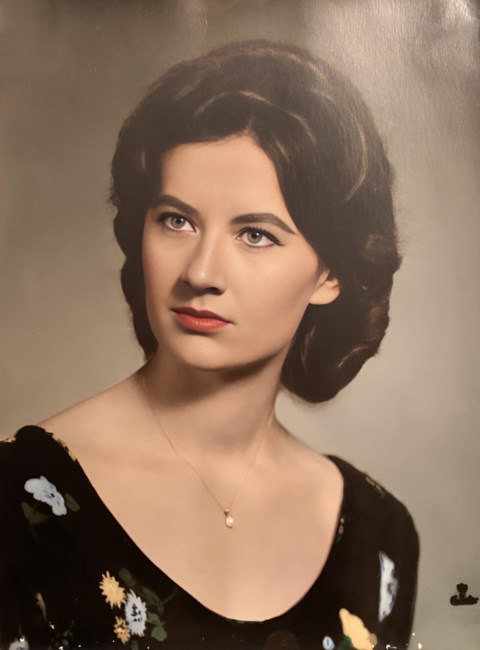
A funeral Mass will be held Saturday, July 19, at 10:30 a.m. at St. Mary’s Catholic Church, 1018 South 7th Street in Temple. A reception will follow in the St. Mary’s School cafeteria. The family encourages a lively exchange of memories about Eva.
Eva Charlotte Hahn was born Eva Karolina Marie Říha on February 2, 1938, in Jihlava, Czechoslovakia, to Jaroslav and Marie Říha. Just months after her birth, Nazi Wehrmacht marched into Czechoslovakia.
As a child, Eva split her time between Telč – where her family lived and her father practiced law – and Studená, home to her maternal grandparents: renowned Czech author Marie Barešová Zezulková (pen name Vlasta Javořická) and František Zezulka.
Eva was the middle of three children born to Jaroslav and Marie Říha. She was preceded by her brother, Jiři (George), who died shortly after birth, and followed by her sister, Jiřina (Georgina, anglicized), who was born just weeks before the Germans reached Prague in 1939.
Like many Czechs, Eva endured great hardships during the war. She witnessed atrocities no child should ever have to see: Her father was harassed, arrested, and sent to a Nazi labor camp for supporting Jewish acquaintances and friends, she watched in horror as the Gestapo abducted the family’s dearest friend from the house across the street, she observed classmates die in an explosion of an abandoned grenade, and she viewed her mother and aunts risking their lives smuggling food to the Jewish prisoners being transported to Auschwitz.
Even as a young child, Eva participated in the Czech resistance: Her grandmother, Marie Zezulka (anglicized), encouraged her to sing banned Moravian folk songs in public spaces — an act of defiance that drew the ire of German officers.
Eva’s hardships continued postwar. She contracted hepatitis, recovering in a United Nations camp for malnourished children. Despite all these struggles, she attested that she “never felt like a victim” and deeply believed that God looked after her and her family.
Following the liberation of Czechoslovakia from the Nazis, Soviet influence quickly took hold of the Czech government. By 1948, Eva’s father was under intense pressure to join the Communist Party. Compelled by the targeted indoctrination of his daughters at school, including their being forced to report on their parents to their teachers, he decided to plan their escape to freedom.
In early 1950, after months of meticulous preparation, Eva and her family fled across the Czechoslovak border into Austria, hidden under sacks of potatoes in a produce van, carrying little more than a backpack, ice skates, and her mother’s jewelry.
After dodging armed Russian patrols in Vienna and surviving a train crash in Bruck an der Mur, Eva and her family made it to St. Martin’s Displaced Persons Refugee Camp in Villach, Austria. Their entry papers were a gift from the British Embassy in Vienna as a gesture of gratitude to Eva’s uncle, legendary Czech pilot Jan Klán (John Kent, anglicized), for his service to the Royal Air Force.
The family spent all of 1950 in the camp in harsh conditions before gaining passage to Australia as political refugees. After a 55-day journey, Eva and her family arrived in Bonegilla, Victoria, in early 1951. To repay the cost of their passage, the Říha family was obliged to two years of indentured servitude.
Eva’s father was sent to North Queensland to work in a sugar cane mill, and her mother worked as a housekeeper and cook on a sheep farm for a wealthy British family who sponsored Eva and Georgina’s schooling.
The sisters attended Catholic school, working on the weekends catching rabbits for food for the family’s sheepdogs to repay their host family. Later, they transferred to Sacred Heart College in Geelong after their parents secured employment there.
Fiercely competitive, Eva graduated as valedictorian, receiving a scholarship to the University of Melbourne. However, her scholarship was rescinded after administration learned she was not an Australian citizen and that her family had applied for a visa to emigrate to America.
Eva enjoyed her time in Australia: She was a talented singer and competitive athlete, placing in several swimming competitions and singing alto on the local Geelong radio. Though she loved Australia, she never adjusted to porridge at meals, eschewing oatmeal for the rest of her life.
Denied higher education, Eva and Georgina, along with their father, began working at Commonwealth Serum Laboratories (now CSL Limited) in Melbourne. Eva worked in the penicillin section and was later selected to help develop Australia’s first batch of the Salk polio vaccine.
After years of waiting and saving every penny for their passage, in 1958 the Říha family finally received their paperwork to come to the United States and set off on the Fairsea to Panama. From there, they flew to San Antonio, the Promised Land. Eva took a job as a lab technician at Southwest Foundation for Research and Education (now Texas Biomedical Research Institute), working in endocrinology research.
While at the Foundation, Eva met surgery resident Dr. H. Herbert Hahn II. They were soon engaged.
In 1962, Herb joined the U.S. Foreign Service as a physician and was sent overseas. U.S. policy prevented Eva from marrying him until she became an American citizen, prompting her to personally corner U.S. Senator John Tower in his office to advocate for her case.
Once she obtained U.S. citizenship, she and Herb were married by proxy in 1963 over telephone when she lived in San Antonio and he was stationed in Okinawa, Japan. Their anniversary spans the International Date Line.
Eva joined her husband on assignment in Phnom Penh, where they lived in a house on stilts with electricity only every other day. Eva frequently helped her husband with his patients, serving as a nurse during late night calls when he did not want to wake his nursing staff.
While in Southeast Asia, Eva and Herb traveled throughout Cambodia, Thailand, Laos, Singapore, and Hong Kong. To help preserve her memories, she picked up art everywhere she went.
When Cambodia severed diplomatic ties with the United States in 1965 during the height of the Vietnam Conflict, Eva was attacked by an angry mob in the Vietnamese section of Phnom Penh, suffering a severe jaw injury from a hurtled brick. She was saved by a Cambodian Cyklo boy, who drove her unconscious to the U.S. Embassy.
Soon after, the U.S. government airlifted diplomatic staff out of Cambodia. The Hahns were reassigned to Accra, Ghana, for Herb’s last few months of diplomatic service.
On the way to Ghana, Herb and Eva toured New Delhi, Tehran, Baghdad, Beirut, and Cairo.
In Ghana, the couple lived in another house on stilts, but this time with stable electricity. With Herb, Eva traveled all over West Africa, exploring jungles, dancing with Ashantis in Kumasi, and visiting the harrowing Elmina and Cape Coast castles off the coast of Ghana. They also visited Togo, Cameroon, Nigeria, Benin, Niger, and Burkina Faso, again picking up art on their travels.
After completion of Herb’s civil service, Eva followed his medical practice to Seattle, Washington; then to Wharton, Texas; and finally, Temple, Texas, where they raised four children: Carla, Christopher, Catherine, and Steven.
All these experiences shaped Eva into a vibrant force as mother, wife, and citizen. Shortly after arriving in Temple, she threw herself into community service, volunteering as an officer in the Women’s Auxiliary of the Bell County Medical Society, the Good Earth Garden Club, and the nascent Republican Party of Bell County.
Forever an ardent anti-communist, Eva worked tirelessly through the remainder of her life to check the growth of socialism and communism in the United States and to ensure freedom and democracy locally and abroad.
In addition to politics, Eva was passionate about children’s education, assisting as a volunteer in Temple Independent School District from 1979 to 1992 and serving on Temple’s Desegregation Committee. Eva knew an educated populace was the greatest safeguard against communism.
Eva loved being an American and loved the land, owning a ranch, running cattle, cultivating crops, and harvesting vegetables. She and Herb created a lasting legacy on their property in West Bell County.
When her children were older, Eva fulfilled the American dream of owning her own business, a profitable antique shop which helped fund her children and grandchildren’s education.
An avid reader with an acute memory, Eva was a woman of wide interests. Knowledgeable in politics and political theory, world history and Texas history, education and pedagogy, world religions, world cuisines, antiques and fine art, agriculture, animal husbandry, and sports (especially soccer), Eva provided a lively and rich intellectual home life for her children, and later, her grandchildren and great-grandchildren.
Eva held court wherever she went, holding listeners in rapt attention. A master storyteller and never fearful of expressing her opinion, Eva captivated anyone who would listen, from all walks of life in all places and of all viewpoints. No one who met Eva failed to remember her. She left an impact on all.
Eva was also a masterful cook who loved to entertain. In her early years in Temple, she hosted huge parties in her home (with her children as waitstaff) for the Bell County Medical Society and the Bell County Republican Party.
Throughout the years, she provided magnificent meals and compelling conversation around her dinner table for her children and their families – and any and all friends they brought along with them. Her generosity knew no bounds.
To the last months of her life, Eva continued to prepare take-home gourmet meals for her children and grandchildren’s families. The sight of a soup-filled Tupperware container will forever evoke fond memories of our beloved Mimi.
Indeed, above all, Eva was her children and grandchildren’s greatest champion, cheerleader, and encourager. She was proud of us to her last breath.
Eva’s passion, spark, and fire will influence generations of her family to come.
Eva was preceded in death by her brother, her parents, and her husband of 59 years, Dr. H. Herbert Hahn II.
She is survived by her sister Georgina and husband Thomas Brand of Lewisville; John and Ashley Brand of Kingwood and Paul Brand of Coppell; and four children – Carla and husband James Mark Clardy of Temple; Christopher and wife Sarah of Round Rock; Catherine and husband Michael Prochko of The Grove; and Steven and wife Julie of Edmond, Oklahoma.
She is also survived by 15 grandchildren – Anna-Maria Clardy and fiancé Seth Falkner, Eve Clardy, Alex Clardy and fiancée Tiffani Walthrop, Benjamin Clardy, and James and wife Katherine Clardy; Reagan and husband JP Styrt, Rachel Hahn, and August Hahn; Austin and wife Michelle Prochko, Veronika and husband Brayden Lynch, Travis and wife Marina Prochko, and Gabriel Prochko; and Hudson, Landon, and Colin Hahn; as well as four great-grandchildren – Aleksander, Nathaniel, and Augustine Prochko; and James Philip Clardy, Jr.
In lieu of flowers, the family requests memorials in her honor be made to Texas Public Policy Foundation at 901 Congress Avenue, Austin, TX 78701; St. Mary’s Catholic School at 1019 South 7th Street, Temple, TX 76501; St. Luke Catholic Church Door-to-Door Ministry at 2807 Oakdale Drive, Temple, TX 76502; or to the Baylor Scott & White Central Texas Foundation, 2401 South 31st Street, MS-20-SO13, Temple, TX 77508; note in the memo line that the gift is for the McLane Children’s Ophthalmology Department in memory of Eva C. Hahn.
Show your support
Add a Memory
Share Obituary
Get Reminders
Services
SHARE OBITUARYSHARE
- GET REMINDERS
v.1.18.0