
OBITUARY
David William Sandercott
11 January, 1960 – 22 October, 2013
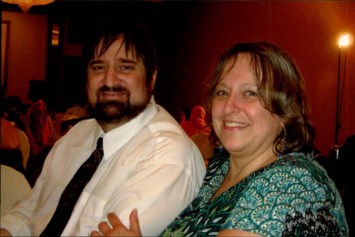
A few weeks ago, my parents were together watching Friends. For those of you familiar with Friends, it was the episode where Phoebe's half-brother Frank brought his new girlfriend to meet her. Frank was 18; his girlfriend was 44. Frank wanted to marry her and have babies right away. Phoebe tried to talk him out of it. She asked him why he wanted babies so quickly. He said "I never had a dad around, but if I have kids, I'll always have a dad around, because I'll be the dad!" My father laughed and said "Yeah, that's pretty much describes me." Dave loved being a husband and a father. His family, and his role as husband and father, were more important to him than anything.
David William Sandercott was born on January 11, 1960, to Mildred and William Sandercott. His parents only married because Millie had gotten pregnant; they lived together only sporadically. Dave had one good memory of his father, of once taking a long walk in the woods with him. Around my father’s eighth birthday, his dad insisted that his mom take him for a visit with her parents on the family farm. When they returned, Dave's father and all of his things were gone. Dave never saw or spoke to his father again. His father never paid a cent in child support. This abandonment of Dave by his father haunted him his entire life; he never got over it.
Dave's mom worked a series of low-paying jobs, mostly waitressing and bartending. They moved around frequently. Dave was constantly being uprooted, changing schools and having to make new friends. They ended up living in Ontario Housing. Dave's mother became an alcoholic, which caused Dave great anguish. His childhood and teen years were difficult. My grandmother did the best job she could to raise my father, but he was forced to learn to be independent at an early age. The friends he made in high school and who are still his friends meant a lot to him.
Dave was one of the kindest people we ever knew. Several years ago, before they tore down Morningside Mall, Dave was in the food court there. He was at the counter waiting to be served, and behind him was a woman with three children. She was telling the children that she had only enough money for one meal, and that this child had to have the food to take his medicine with. Dave then ordered meals for each child and the mother, paid for them, then took the drink he ordered and left before the mother could realize what he had just done for her and her children. He told only my mother about this when he came home. He didn't want to tell anyone else he'd done this; he wasn't even going to tell my mother, but he decided to tell her because he told her everything. Dave was always there when friends or family needed him. He would spend hours on the phone talking a friend through a painful divorce, or a serious illness, or depression, or anything other problem they were having. Dave was kind, caring, understanding, and comforting. He gave strength to others, and was a source of strength to everyone in his life.
My father was a great storyteller - he always had interesting stories of all of his experiences, good or bad, whether about his time in the restaurant business, his experiences in Scouting or any other experience that came to mind. He was a quiet man, but when he spoke always had something interesting to say.
My father was also very interested in his heritage and genealogy. Although he never spoke with his father after he left him, the fact that his father was half-Jewish made him interested in his Jewish heritage. One job that he took while working in the restaurant business was general manager of Deli Beijing, a kosher Chinese food restaurant. He spent a lot of time around learning about Jewish dietary laws and other parts of Jewish culture. It connected him to a part of himself that he always wanted to be connected to, but was denied him until then.
Dave always worked hard to be the father that he never had. He did his best to instill the values of kindness and conscientiousness within us, values that he himself had in abundance. Dave loved being a father, and my brother and I always enjoyed spending time with him. He was strict but loving, and he always played with, joked with, and above all, took care of us. When I joined Beavers, Dave became a beaver leader. He stayed involved in Scouting for the entire time both Daniel and I were involved. He joined us on numerous camps and other activities. When we found out that my brother Daniel was autistic, it was my father who did the research on the best way to raise him, with the rest of us following his lead. My father stayed home with Daniel for several years from when Daniel was a toddler until his first couple of years of school. When Daniel first started playing hockey, Dad spent a lot of time in the changeroom helping him and the other kids and their parents, and on the bench helping out. Over the past year or so, Dave did not attend many practices, because of his declining health, but was generally able to attend games. He took Daniel with his hockey team to a tournament in Boston a couple of years ago.
His time and effort spent raising Daniel eventually led to him working with developmentally disabled children at Maplewood High School. He put the same level of effort into his work as he did into raising us. Eventually, he became an adult food school teacher at Maplewood and later a baking teacher at Timothy Eaton Business and Technical Institute, where he got to apply both his school experience and his restaurant experience. He was well-liked and respected by his students. More than once a student, usually male, told Dave that he wished he was his father.
His involvement in Scouting played a major role in my father’s relationship with Daniel and me. He made sure we got involved in the movement as soon as we were both of age for Beavers, and his involvement as a leader allowed him to be with us and to give back to the organization that was such an important part of his youth.
Dave loved Scouting, and he loved the people he met in Scouting, many of whom became lifelong friends. His time spent camping was among some of the best moments of his life. He enjoyed being at Camp Adventureland both as the camp cook and as a village leader. One picture of him in particular always comes to mind - the one of him with both Daniel and me, in front of our house as we prepared to go camping. Whether as part of Scouting or with family, camping was a source of excitement and joy for my father, and he wasted no opportunity in showing us the outdoors. It saddened him when he became ill and it was too difficult to work at Camp Adventureland or be a leader. His time in Scouting enriched his life as much as it enriched the lives of the people he worked with.
Out of everyone in my family, my father was the calmest and the most level-headed. Indeed, in many situations, whether at home, at work, or otherwise, he was often the one who best focused on the task at hand even in the most dire of situations. When others panicked and were unsure of what to do next, my father was so often the one to take charge. These were nothing more than natural qualities of his, that went hand in hand with his enduring kindness.
Dave was working as a baking teacher at Timothy Eaton the first time he became ill enough to be rushed to hospital. Over the next several years, his diabetes destroyed his health. He left work on disability about eight years ago. He lost his eyesight three times. He had innumerable laser surgeries to repair his retinas, and several surgeries on his eyes overall. The surgeries caused my father to develop cataracts, which caused his last bout of blindness. However, they were discovered just in time for him to have them removed and his lenses replaced; he could see better than he'd been able to in years. I remember hearing the news of this; it was one of the few times the news of something like cataracts was a good thing. This happened a couple of years ago, and the day they took his bandages off and he looked at my mom and handed her his white cane, saying "I don't need this anymore", was one of the happiest moments my parents had since he became ill. He was able to see again.
However, his kidneys had slowly stopped working, to the point where Dave was on peritoneal dialysis for the past six-and-a-half years. He was hooked up to a machine every night for ten hours. He was put on the kidney transplant list, but the type of dialysis he was doing caused him to gain a lot of weight, especially around the abdomen, so, although he was moving up the transplant list, he was not eligible for a transplant until he lost weight. Over the past several months, we watched him get weaker and weaker, tireder and tireder. He lost his appetite; he started losing weight, but not on purpose. He was often too tired and in pain to even leave the house. We were all very worried about him. My mother worried that they weren't doing enough for him at the kidney clinic, but he thought that she was being paranoid. It was painful to watch his health deteriorate. The doctors at the kidney clinic wanted Dave to switch from peritoneal to hemo dialysis, which we all hoped would make him feel better and help him lose more weight so that he could get back into his spot on the transplant list. They were going to have him go to St. Michael's Hospital to redo the transplant work-up.
This August, my mother had to have knee replacement surgery. Two weeks after the surgery, Dave came into her room and said "Sue, I have to go to the hospital, I'm afraid I'm going to lose my foot." His right foot, which had no visible wound but had been causing him pain for several weeks, had started to turn black. He'd already had two toes amputated from that foot a couple of years ago. My father went to Scarborough General's emergency department, where they were hopeful. A few days later, he saw a vascular surgeon who told Dave that he would likely have to have his leg amputated. A couple of weeks later, it was confirmed that he would have to have his right leg amputated above the knee. My grandmother died in 2002 of sepsis after having her legs amputated. When my father found out that he was having his leg amputated, he was terrified of the same thing happening to him. The prospect of becoming even more disabled scared and depressed him. The surgery took place on October 9, his mother's birthday. The surgery went well, and his wound was healing perfectly. On Monday, October 21, Dave became tired and unable to stay awake. When my mother visited him in the hospital in the evening, he was on oxygen. He was barely responsive, and could not be woken. The nurses seemed to not know what was going on. My mother insisted that they get a doctor. She then went home to be with Daniel, my brother. The doctor ordered a CT scan and blood tests; the CT scan showed nothing, but the blood tests showed a spike in his white blood cell count, which generally means an infection. They gave him powerful antiobiotics by IV. His blood pressure and heart rate kept dropping, until his heart stopped. They tried to restart his heart, but were not able to. My mother got the phone call at 5 a.m. on Tuesday, October 22, that Dave Sandercott had just died. They believed that sepsis killed him, but they didn't know the source of the infection. We declined an autopsy; we saw no point in having one.
I’ve thought a lot about “home”. In Scouting, a scouter who has died is said to have “gone home”, after the phrase written on founder Lord Robert Baden-Powell’s gravestone. During the last days of his life, when he was trying his best to recover from the surgery, all my father wanted was to return home. During the last conversation that he had with my mother, he talked simply about how lonely he felt, how much he missed her, and above all, how much he wanted to be back home with her.
Home is a place where one feels most at peace with his surroundings. Even as he struggled with his health, at home my father was surrounded by the people who he loved most. In spite of the difficult life that he had growing up, he managed to do everything within his power to ensure a good life for his family. He had a strong sense of decency and integrity. He was a good man to everyone he met. This was not the way in which he wanted to “go home”, but I hope that he has found peace.
* * * * * * * * * *
SANDERCOTT, David William
Passed away at Scarborough General Hospital on Tuesday, October 22, 2013 in his 54th year. Beloved husband of Susan Hudson. Loving father of Robert and Daniel. Predeceased by his mother, Mildred Sandercott (Osborn). Family and friends may visit at Giffen-Mack Scarborough Funeral Home & Cremation Centre, 4115 Lawrence Avenue East, West Hill, Ontario (one block west of Kingston Road), 416-281-6800 from 7-9 pm on Saturday, October 26, 2013. A service to be held int he chapel on Sunday at 2 pm. Cremation. As an expression of sympathy, memorial donations may be made to The Kidney Foundation of Canada, or to the Canadian Diabetes Association.
Show your support
Add a Memory
Share Obituary
Get Reminders
Services
SHARE OBITUARYSHARE
- GET REMINDERS
v.1.18.0