
OBITUARIO
Daniel Weber Miller
24 enero, 1926 – 1 febrero, 2015
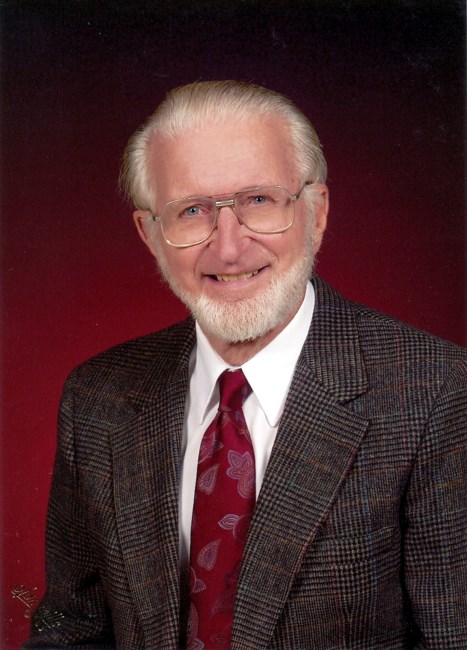
Daniel Weber Miller died February 1, 2015 in Bloomington at the age of 89 from complications related to Parkinson’s Disease. He moved to Bloomington in 1951 as a postdoctoral fellow at Indiana University (IU), rising to full professor in 1962. For almost forty years, he was a dedicated teacher and researcher in the IU Department of Physics, and provided outstanding service to the university in a wide range of leadership roles. He was also a dedicated community member, wonderful husband, father, grandfather and great-grandfather, role model and mentor, and beloved by all who knew him.
Miller was raised in Columbia, Missouri. He graduated from high school at the age of 16, attended two years of college at the University of Missouri and then entered the U.S. Navy in 1944 at age 18 during World War II. After graduation from radar school at Navy Pier in Chicago as the #1 student in his class, he was chosen to be a fire-control radar instructor until his honorable discharge from the Navy in 1946. He returned to the University of Missouri where he completed a B.S. in Electrical Engineering in 1947. He then attended graduate school at the University of Wisconsin, receiving his Ph.D. in Physics in 1951. Miller’s first-author paper describing his doctoral research was one of five significant papers on Nuclear Physics selected to represent the year 1952 in the American Physical Society's anthology, "The Physical Review: the First 100 Years.” His research results on low-energy neutron total cross-sections led directly to the development of a prominent early model of the atomic nucleus, the "cloudy crystal ball model,” which was the basis for the optical model of nuclear reactions and is still in use today.
Dr. Miller’s research at Indiana University began when he arrived in 1951, using the original Indiana University cyclotron. He and his Ph.D. students studied nuclear elastic and inelastic scattering from light atomic nuclei. He extended this research over five summers at the Los Alamos Scientific Laboratory Cyclotron, where he also served as a consultant, and then later at the IU Cyclotron Facility.
Miller was a devoted teacher at Indiana University. Beginning in 1952 he taught courses at the 100-600 level, with special emphasis on 100 level courses and was described by some of his students as their best teacher ever. He was known as an excellent teacher of non-science majors. In addition, seven students received Ph.D. degrees under his supervision during the period when the most active research was underway at the Indiana University cyclotron.
In addition to excellence in teaching and research, over the last thirty years of his career at IU, Miller provided leadership in numerous positions including as Associate Dean of the College of Arts and Sciences, 1962-64, Acting Chair of the Physics Department, 1964-65, and Associate Dean of Research and Advanced Studies, 1972-73. He served on numerous IU committees, including the University Faculty Board of Review and the University Science Advisory Committee.
In 1965, as Acting Chair of the Physics Department, Miller played a transformative leadership role for the IU physical sciences co-chairing the successful proposal to the National Science Foundation for a Center of Excellence grant to IU. This grant had an extraordinary impact on IU’s physical sciences program in the breadth of its support, including funds for a new cyclotron, which became the Indiana University Cyclotron Facility (IUCF), a computer science department, and additional faculty for the physics and chemistry departments. Miller then served as co-principal investigator for the construction of the new Indiana University Cyclotron Facility (IUCF), then as the IUCF Associate Director from 1971 to 1979, and Co-Director from 1979 to 1986. During this period, the IUCF’s position as a major international center of nuclear physics research was further strengthened. Miller took formal retirement from IU in 1991 but continued to do research at the IUCF for several years thereafter.
Another area where Miller provided outstanding service was intercollegiate athletics. He was a member of the Indiana University Athletics Committee from 1968 to 1978, and served as Chair of the Committee and the IU Faculty Representative to the Big 10 conference and the NCAA from 1973 to 1978. He chaired the successful search committee for the new IU Athletic Director in 1974. At the Big 10 level, he was one of the authors of new Big 10 academic progress requirements for athletes that went into effect during his term. He was made an honorary “I Man” and awarded the Bill Orwig Medal in 1978.
In 1991, in recognition of his distinguished service in so many areas, Miller was awarded the Distinguished Service Award for the Indiana University Bloomington campus.
On a national and global level, Miller was a Fellow of the American Physical Society (APS), Chairman of the Publications Committee of the Nuclear Physics Division of APS, and a member of the APS Publications Committee, the Bonner Prize Committee, the Resources Committee of the Division of Nuclear Physics Board of Directors of the Midwestern Universities Research Association and a delegate to the Argonne Universities Association.
Miller was part of a highly academic family. His father was a university professor and Dean of Agriculture at the University of Missouri and his mother was one of the first women awarded a Master’s degree in Botany. His two brothers (at the University of Wisconsin and Cornell) and his brother-in-law (at the University of Illinois) were all professors of physics. Miller’s older sister, Elisabeth M. Hanson, aged 97, published a book last fall on the ecological and anthropological history of the central plains of Illinois, pursuing the generations-long interest of their parents in the agriculture of the Midwest. One surviving nephew, Andrew Hanson of Bloomington, is an emeritus professor of Computer Science in the School of Informatics and Computing at IU, and former chair of his Department, following in his uncle's footsteps.
Miller was a devoted family member. Upon his graduation from the University of Missouri in 1947, he married Carolyn Hunt and together they raised two children, Deborah and Douglas. Among their activities in Bloomington, they were charter members of St. Mark’s Methodist Church, in the early days holding Sunday school classes in the basement of their home. When Carolyn died in 1979, Miller carried on with great fortitude until he met and married Kathryn Collier Johnson of Bloomington on May 12, 1985. Over almost thirty years of marriage, they were the beloved heads of their shared family of six children, ten grandchildren and nine great-grandchildren. They were also active in the Bloomington community, including WonderLab and the First Presbyterian Church.
Kathryn Miller preceded him in death on March 17, 2013. He was also predeceased by his older brothers Edward and Robert. Miller is survived by his sister, Elisabeth M. Hanson; his children, Deborah (Gerald Gowan) Miller and Douglas Miller; his step-children, Linda (Dave) O’Rell, Karen (Jim) McMorran, Tara (Tess) McKibben, Jay (Kris) Johnson; ten grandchildren, Devon Miller-Gowan, Darien Miller-Gowan, Jennifer McClellan, Elaine O’Rell, Rhonda (Wayne) Elks, Beth (Eric) Salesky, Andrea McMorran, David Andrew (Autumn) McKibben, Phillip (Maria Siriano) Johnson and Leslie Johnson, nine great-grandchildren and 28 nieces and nephews.
Those who knew and loved Dan Miller will always remember his great appreciation of life and learning; his care and thoughtfulness as a family member, friend, role model and mentor; his appreciation for peoples of all background and cultures; his extensive world travels; his love for music and his own playing of the harmonica and the piano; his long-time enjoyment of ham radio (with call letters KQ91), and his support of the ham radio chapter at IU; his love for the theatre; and his passion for IU sports of all kinds.
A memorial celebration service for the life of Daniel Weber Miller will be held on a date to be determined in the spring of 2015. Donations in his memory may be made to the IU Physics Department, the Bloomington WonderLab (science discovery museum), and the First Presbyterian Church of Bloomington.
Muestre su apoyo
Comparta Un Recuerdo
Comparta
Un Obituario
Obtenga actualizaciones
Servicios
COMPARTA UN OBITUARIOCOMPARTA
- RECIBIR RECORDATORIOS
v.1.18.0