
OBITUARIO
Alfred Hucknall
18 marzo, 1925 – 19 noviembre, 2011
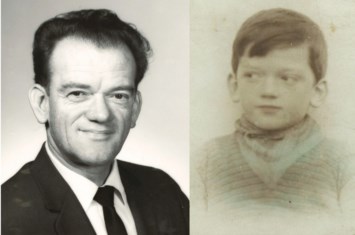
The life of Alfred Hucknall - much loved and missed husband, father & grandfather. This was dictated in 2001-2003 to his daughter-in-law Katie, while Dad still could recall the events of his life. It is not edited, as these were his words as the time, you may notice that his thoughts become more random towards the end of his biography. He was a great writer in his best years and I am sure he would have written it quite differently if he was able, but it is good to have his recollections of life before he became unable to tell us his stories, although he did recall many events in his life up to the end.
THE AUTOBIOGRAPHY OF ALFRED HUCKNALL
Very early in the 19th century, Barrow-in-Furness was just a small fishing village with just 300 inhabitants. In 1945, (when I was just 20 years old), its population was 66,440. This was largely due to working of the rich iron mines of the iron ore industry.
The earliest recollection of my life was the wonderful smell of my mother’s apron whenever she picked me up to console me. Christened Alfred, I was the seventh child in the Hucknall family of ten. (The last one died at birth. He was the second of twins). Born in 1925, on March 18th, just about six years after World War 1 had been proclaimed to be the war to end all wars. This of course, at that time, entitled it to be called “The Great War.”
I must have been four years old when a dramatic event registered the start of my conscious memory. Lena, my fourteen year-old sister, who had been like a mother to me in those first few years of my life, had an accident that severely bruised her upper thigh. A few weeks before, she had started her first job, in service, as it was called, working for a doctor and his wife, as a live-in-house maid. When the bruise failed to improve and began to appear septic, the doctor, without giving her any advice, sent her back home where mother immediately took her to our family doctor and Lena was taken to hospital. Shortly, it was concluded that it was either her leg or her life, and her youthful, shapely leg, was quickly amputated.
The actual event that marked the start of my conscious memory was being taken by mother to visit Lena in the hospital, after the surgery. Mam, as we all called our mother, carried a small bag of fruit as we walked over a bridge, on our way to the hospital. Soon after we arrived at Lena’s bedside, she opened the bag, smiled at me, and gave me a banana. Both the smiles, and the banana, were a wonderful treat for me. For several years Lena had to walk with a crutch, as false legs were in the development phase, in the early thirties. It was a dreadful experience for a beautiful young woman to face, but Lena did not despair.
My dad, James Hucknall, volunteered to fight in the trenches of France in W.W.I. I believe he was trained to be a machine gunner, but he never wanted to talk about the war.
In the late summer of 1930, having earlier that year reached five years old, Main made me aware that it was time for me to start school. I stoutly resisted. Clinging to Mam’s skirts had been all of what life was about. I dreaded the thought of being anywhere without Main nearby. No doubt I must have been dimly aware of a larger world beyond the confines of my overcrowded home at 8C Brig Street, but the trials and tribulations of my six elder siblings provided all the excitement I needed for a five-year-old. I simply had no interest in a formal education. The mischievous escapades my older brother George frequently got up to were far more intriguing. Being four years my senior, he had a lot to teach me on how to add some excitement to my life, without being too endangered. First, however, I must outline the general background to my family’s life in Old Barrow, or Barrow Island, as it was officially known.
My parents, James and Beatrice Hucknall, were married in the first decade of the 20th Century, and soon moved to Barrow-in-Furness, on the northwest coast of England, where my father was able to find work at Vickers-.Armstrong LTD, a large shipbuilding company. They took residence eventually, in a one- bedroom apartment, which was part of a relatively large series of multi-level, red brick apartments. Their first child, John William, was born in 1909. At this time, five years before the start of The Great War, my father was 21 and my dear mother was 20. Two years later, my eldest sister Betty was born, and in 1914, when The Great War 1 started, Lena was born.
The Great War, started by Kaiser Wilhelm, representing the Central European Powers (Germany, Austria-Hungary, etc.) and the Allies (Great Britain, France, Russia, U.S.A., Italy, etc.). Just after The Great War ended, in 19 18, Minnie was born, and in the early twenty’s, George and Sarah soon followed. I appeared in the family in 1925, two years after Sarah, in the normal freezing cold southwesterly winds that blew in over the Irish Sea. During the first few decades of this century, contraceptives were practically unheard of, or at best most unreliable. Large family’s were quite common and I was the seventh born, around about the middle of a surviving family of nine. In many ways, being a mischievous boy, I couldn’t have picked a better spot to be. Being naturally left-handed, I was quick to see the humorous side of life. Stan Laurel was a comedian, and his partner, “Ollie,” (the straight man) was right-handed. It was my older brother George, who guided me in acceptable boundaries of mischief, and where and how, to steal food, to appease our ever hungry young stomachs with fancy foods. Far more tasty than the plain white bread my mother cooked for us!She would turn in her grave if she learned of all the tricks we got up to. All my life I have been very fond of fish. Living in England, it was most likely to be plaice, herring, or sole.
At an early age my Dad taught me how to ride a bicycle. When I was in my early teens, my friend Tom Turner and I toured the north of England, stopping at my sister Betty’s home in Manchester. When we left it started to rain, and Tom and I pedaled from Manchester to Barrow (100 miles) in continuous rain! This was quite a test of stamina (or was it stubbornness?). Tom’s mother and father were Alf and Francis Turner. They were a lot of fun. Tom’s mother loved to play cards with me, and Tom accused me of stealing his mother!
My Dad gave us all a penny-a-week pocket money, which we would spend on a small bag of candy, or toffee as we called it in England. But George showed me how we could legally earn considerably more. Vickers-Armstrong generated a large amount of scrap metal and the smaller pieces, together with a large amount of other industrial rubbish, was taken in trucks, to what we called the tip. No matter how small, any scrap metal collected in a sack could be sold at the local scrap metal dealer.
Later, before I progressed into the junior elementary schools, we gained some dignity to our family when we moved from a one-bedroom home at 8C Brig St. to a three-bedroom house at 22 Reynolds Place. I made my own friends, one of whom was Tom Turner, who, to my good fortune, became a close, life-long friend. Even my mother, who always had a critical eye, was won with Tom’s easy charm. Tom was a friend through all my early years and beyond to manhood. Apart from being an attractive guy, he was engagingly charming and made friends with everyone he met. Tom and I followed separate paths to Canada (and eventually the USA in 1952, but I am jumping the gun at least a decade.)
At age eleven, Tom and I were ready to go into senior elementary school, Holker Street School. I discovered that I had a quick mind in mathematics and the enormous variety of the English language intrigued me. However, my teacher told the class that Hucknall is the only one in the class that he would recommend for grammar school, which was an essential first step in the path to university. I had refused because I preferred to stay with my buddies. I did not yet realize how very small my world was. I guess I had yet to study geography! It was here, at about 13 years of age, just outside of the Holker Street school grounds, that Eric Ball, the school bully, fought me after school.
I was very lucky to get a geography teacher with a great sense of humor. We knew him as Mr. Hodges, he wouldn’t hesitate to throw a piece of chalk at your head if you were not paying attention, and he was remarkably accurate. However, I became much more aware of the world at large.
Another important subject for me was mathematics, although in England we called it arithmetic. Mr. Keast taught us basic arithmetic. The more complex math, based on the logarithmic scales of slide rules, we learned later in Technical College.
Soon, it was early in 1939, and Adolf Hitler was in control of Germany an Austria, with plans to take over the whole of Europe. It was about this time, with war seen as inevitable, that Anderson shelters were issues as a home-built air-raid shelter, to all families that were willing to dig a large deep hole in their garden. It was all built of corrugated steel sheeting, which required bolting together, with a small entrance hole at one end. Then all the earth that had been dug out from shaping a deep square hole was thrown on top of the shelter. All the family was in this shelter when the German bombers made Vickers Armstrong their primary target three years later.
Having recently reached the age of 14, my life was about to reach early manhood. This was the age I could legally get a full-time job of 40 hours a week. I was a young man! Tom Turner and I decided that working in the Drawing Office at Vickers-Armstrong would be the best goal, so we applied for jobs as “office boys” in the “Light Ordinance Drawing Office, “abbreviated to “LODO.” As we both had plans to become draftsmen, this was a good opportunity for us to become familiar with mechanical drawings. I worked in the vault where copies of all the drawings were stored.
When we were fifteen, we became eligible to start a five-year engineering apprenticeship. I was fond of whittling wood, so becoming an apprentice pattern maker, in the Pattern-shop, was an easy choice for me. Tom made the same choice.
It was about the same time (1940-1941) that Adolf Hitler’s fleet of bombers was making their targets on such places as Vickers-Armstrong. One night, in winter of 1941, his bombers made Vickers-Armstrong-Naval Construction Works their primary target. I believe they dropped a land mine on a parachute; whatever it was, the pattern-shop was leveled to just flat concrete.
It was around this time (1941) that Churchill asked for a part-time volunteer army to be formed. First it was called the L.D.V. (Local Defense Volunteers). However, after a short time it was changed to “Home-Guard” (when Tom and I volunteered). It was a most eventful year for Tom and I, and three other apprentices who we had never met. They were Tom Whitaker, Jim Patterson, and Cyril Wearing. The five of us, together with Tom and I and the other apprentices were interviewed by a visiting group of Vickers executives. It was the most stressful interview I have experienced in my entire working career of mechanical and aeronautical engineering. As a result of these interviews, the five of us were chosen to work at Vickers-Armstrong Supermarine Works.
Some time that same year, the famous Prime Minister, Winston Churchill, who led Britain during World War II, (it was later, after the Japanese bombing of Pearl Harbor, that the global war was christened World War II), paid Vickers Armstrong a visit. We felt honored to have seen this great man stride confidently through the Works. Tom and I volunteered to join the “Home Guard.” This was a part-time defense army of civilians. In fact, when it was first formed as the “Local Defense Volunteers,” Winston Churchill didn’t like the name, and decreed that it would be named Home Guard.
We received training by a regular army sergeant, to launch anti-aircraft missiles. Each projector guidance system launched two missiles (or rockets) preset to explode at whatever height is chosen. The sergeant arranged for us to go to Walney Island, which looked out over the Irish Sea. In a chosen area, we were told that we would experience the feel of firing off one rocket, at a predetermined range. It prepared us for the real thing, when a full battery of artillery, with a complement of two missiles on each launcher at a predetermined height, would bring down several of the German bombers in flames. For whatever reason, maybe our journey south to work at Supermarine Aviation Works (in 1943), this rocket shoot at the bombers was not to be. I was 18 years old when Tom and I left Barrow-in-Furness, in our British Army uniforms, and boarded the train that would take us south to Winchester, that ancient city in the county of Hampshire. Surely it was mere coincidence that Alfred from Barrow would find himself in the city where the first King of England, “Alfred the Great,” (886-889 AD) reigned as King after defeating the invading “Normans” (from the European Continent in the area now called France). A replica of King Alfred, holding a large sword and shield, prominently occupies High St., the main shopping Street. Winchester is where I, eventually, would be most fortunate to meet my dear wife, Yvonne.
First and foremost, I had to visit Supermarine Aviation Works, which was now located in Hursley Park, near the small village of Hursley. All of this had been arranged by the Apprentice Supervisor, who had also picked out clean and reputable “digs” for us. The term “digs” is a slang expression in England, which simply means that some family, other than your own, is providing you with a home. Similar to “board & lodging,” which means that some family is providing you with both food and a bed.
Cyril Wearing and Jim Patterson were first taken to a home at, or near to the top of, Stanmore Lane. Then Tom Turner and I were taken to the home of Mrs. Marsh, about half way down the hill of Stanmore Lane. Tom Whittaker (who was the 5th class apprentice chose at Barrow) was put near the bottom of Stanmore Lane. (Recently Tom told me that Tom Whittaker decided to become an officer in the Merchant Navy). Cyril Wearing fell in love with the daughter of his landlady (which was of no concern to Jim), so he arranged to come and live with Tom and me.
Of more importance to me however, is outlining the genealogy of the “Designer” of the Supermarine Spitfire, which, with two or three guns in each wing, was famous for shooting down German bomber and fighter airplanes. The original Chief Designer was R.J. Mitchell. When he died, at the age of 42 (about the time World War II started) he was replaced by his Assistant Chief, Joe Smith.
What is of greater importance than the Spitfire is how I first met Yvonne, the beautiful young woman who was to become my wife. Tom Turner had previously met Yvonne at a dance. Nest time he saw me, he said, “Huck, I have found just the girl for you.” At the time I was 24 years old, and when Tom introduced her, I was very impressed with her innocent charm and beauty. This occurred at a New Years Eve dinner in the Norman Mead Hotel as we toasted in the start of 1949.
One year prior to meeting Yvonne, Tom, Jim, and I went on the public busses to Southampton University, as part-time engineering students (1943- 1946). We earned graduation in 1946. From age 21-26 (1941-1951), Jim and I played Rugby for the town of Eastleigh (which is about mid-way between Winchester and the large city of Southampton). I played in the position known as “hooker.” Jim played as quarterback. The position of hooker is in the middle of the front row (of three). The quarterback throws the oval ball into the tunnel, formed by the two opposing front rows. In one of the London newspapers, in the sports page, there was a short commentary on our game: “Hucknall played like a demon.” He was the most constructive forward on the field, and stood out above others.
Getting back to meeting Yvonne, we dated for 3 or 4 months, and then she said she wasn’t ready for a serious relationship. She went on a two-week working holiday on a farm. There was no work left to do when she arrived, however she was given the choice of going back to the Telephone Exchange in Winchester, or staying there on the farm (in the event that work in the fields of the farm became available). Yvonne chose to stay. I wrote two love letters to Yvonne while she was on the farm, expressing how much I missed her while she was away. I was determined to win her, by hook or by crook!
After 3 or 4 months I phoned her, and we established a more firm relationship, and she eventually agreed to be my bride. We were married in March of 1951, and I was aglow with pride of my beautiful wife. The total cost of the wedding was 76 English pounds, including all our clothing, drinks, taxis, wedding ring, and honeymoon.
At this point, both Tom and I worked as designers in the aircraft industry. Tom told me that he had been offered a job in Toronto, Canada. I was offered a job in Fort William, Canada, and they wanted me as quickly as possible. They would pay our airfare to Montreal, where Canadian Car and Foundry Company had their headquarters.
When we departed from London Airport, in what I recognized as a refurbished World War II Bristol Bomber with four Radial Engines, I didn’t say a word about it to Yvonne. When we were about halfway across the Atlantic Ocean, one engine spluttered briefly, and almost stopped. However, the pilot managed to get it working normally. Montreal, here we come!
Upon arriving and visiting the company headquarters, we went on the train to Toronto, where Tom Turner welcomed us. For the weekend we stayed at the parents of Ruth, who later became his wife. They arranged a “Welcome to Canada” party for us, after which we were given a tour of all the grand spots in Toronto. We then took an overnight train to Fort William, which was about 1, 000 miles on the west side of Lake Superior. The man who first greeted us at the train station was actually my supervisor in the drawing office, where I was going to check the work of the draftsmen.
The company had made reservations for us at one of the two hotels there. It was a dismal place, and we were determined not to spend more than one night there. An old friend of mine in England knew of a friend of hers who moved to
Fort William many years earlier, and so she gave us her address. We quickly got in touch with her to inquire if she could recommend anyone we could stay with until we found other accommodations. She thought a Mrs. Humphrey, who was English and whose husband had recently died, might enjoy our company for a few days. She greeted us warmly, and we stayed with her for two weeks until we found more permanent accommodations. We rented two rooms, one of which was a bedroom, and the other a substitute for a kitchen.
Paul and Iris Jensen, from Denmark, where the first couple we made friends with. The only house they could find for rent was close to the railroad! They had a baby just a few months old. Paul was one of the draftsmen whose work I checked. Canadian Car and Foundry Co. had a contract with the Canadian Government to design an airplane (probably a fighter, which is why they hired me, having my design experience at Supermarine). Another couple, whose company we much enjoyed, was Herb and Mary Meuffels, who were from Holland. There were very humorous.
The contract with the Canadian Government was canceled, and after two months a large percentage of the shop workers were laid off. I was not. However, I was unhappy with the boring work they were giving me, so I wrote to both Lockheed and Consolidated-Vultee Aircraft Corporation (who later changed their name to Convair). This was in San Diego, which was a city that attracted me, so when they made me an offer, I quickly accepted.
First, we had to visit the American Consulate in Winnipeg to get a permit to work in the USA. It took five months to get the visa, so I had to continue working at Canadian Car and Foundry Co. in the meantime. I used this time to learn how to drive a car (having never learned to drive a car in England). I was a cyclist 7 only! Here I am now, in the year 2001. I still love to ride a bike, but capable of riding no more than 15 miles (and never in the rain!).
Anyway, to get back to Canada, in 1952. Once I obtained my visa, a Canadian friend named Glen drove me down to Minneapolis to buy a car. The best buy was a new Plymouth, costing about $2,500, which I bought. When we returned to Fort William, we could stay there no more than two days. This was to avoid purchase tax to the Canadian Government. It took about a week traveling to San Diego. In their own car, we had the company of our Canadian friends, Glen and his wife Joan, along with their 2¼-year-old son. At their request, we stayed in Las Vegas for two or three days. However, gambling was not on our list of things to do! I was anxious to get to San Diego and start working. But there was one more stop I had to make. We stopped in Los Angeles and stayed overnight with old friends, Geoff and Irene Davis, who had also worked at Supermarine in Hursley Park, near Winchester. Yvonne told them that she was four months pregnant with our first child. We certainly enjoyed visiting old friends, and Yvonne was congratulated by Irene.
We arrived in San Diego on November 4, 1952 (the same day Dwight Eisenhower was elected president). I wasted no time in calling Consolidated Vultee Corp (Convair) and told them I had arrived and ready and willing to start working as soon as possible! I was to work in many places in San Diego, to provide income for my family. Once I was hired I became a member of what was known as the Foreign Legion. When I wrote home and told my parents of this, my Dad was disgusted. “They speak our language, how could they call you foreign?!” The Foreign Legion worked in a Quonset-hut on Kettner Blvd. (about two short blocks from the main offices).
As Yvonne was pregnant with our first child, we had to rent a home with all amenities. We found one we liked on Arnold Ave. Soon our first son, David, was born on April 8k”, 1953. We had to wait until after we had our second son, Joe, born October 1, 1954, before we had our first daughter, Sandra. Before Joe was born, we moved to a three-bedroom home on Utah St. Around about 1955 we took a trip to the Grand Canyon with David, who was under 2 years old. We left Joe, who was under 1 year, with Freda to take care of him. Herb and Mary Meuffels, who were our friends in Canada, came from Canada to join us.
We decided to invite Yvonne’s mother Freda to stay with us. Being a first class classical pianist, she was a joy to live with. She lived with us thirty years, and died at the age of ninety. It happens to all of us of course, eventually. I hall be happy to reach 88!
I still remember what fun Joe and Dave had when they rode their tricycles around, racing against each other. It’s not surprising that when they got to their teens they become strongly interested in auto racing. An old friend from Supermarine’s, Barry Ward, took all the males in the family to the Riverside track to watch professional racing. Dave and Joe were more keen and excited than I was.
In 1957 we were happy to buy our first new home in Fletcher Hills, at 2556 Calvin Lane. We had great next-door neighbors there, Jack and Peggy Totten. Jack persuaded me to play golf with him.
It was while we were living in Fletcher Hills that Karen was born in 1965. Soon after she was born, I said to Yvonne, “We really hit the jack-pot, for our last child.” Also, it was while we were living on Calvin Lane that I taught Yvonne how to drive. When she was a competent driver, we decided to buy a station wagon with an automatic transmission. After seeing me use a stick shift on the Plymouth, Yvonne was insistent about having an automatic (even though she had learned to drive the Plymouth). Having four children, Yvonne and I were in agreement on the safety offered with an automatic.
After being in the U.S.A. ten years (about four years before Karen was born), we had saved enough money to take Joe, Sandra, and Dave back to England, on a BOAC non-stop flight to London. It was half empty and there was plenty of room for all of us to sleep. The jet airplane landed smoothly on the runway and we were all excited to see the country of our ancestry. About ten year previously, Yvonne and I had departed from England in a noisy propeller powered airplane, taking 17 hours to cross the Atlantic (including a stop for refueling in Greenland). My brother Joe was at the airport to meet us, and he drove us to his home, where we needed two or three days to get adjusted from the jet lag. When we had recovered our sense of well-being, we agreed that we would first head north to see my family in Barrow. It was a treat to see them all again, and visit the Lake District.
We spent five weeks visiting all our friends and relatives, and thoroughly enjoyed ourselves. It was sobering to face up to the thought of returning to the U.S.A. and going back to work. Little did we realize that, through various circumstances, it would be twelve years before we could return again. Such are the vagaries of life. To be realistic however, U.S.A. is where I needed to go, to earn the money before we could return to England again. We were citizens of the U.S.A., and several of our family, including Yvonne’s mother, were dependent upon our support.
Many years later, in 1996, we would be back in the Lake District again, admiring an attractive hotel, which was located near Grassmere Lake. Yvonne and I agreed that if we ever visited the Lakes again, we would stay in that hotel for a couple of days.
When we returned to Fletcher Hills, we found Yvonne’s mother Freda in good health and still finding time to play the piano like a professional classical pianist. She was a most entertaining seventy-year-old to have in your home, and we were most fortunate to have her with us.
As we now had a total of seven people in the family, we needed a new larger home that would provide adequate space for all of us. The large house we found is where we are now, and have been for thirty-four years. We have no plans to move again!
Going back to when I was an apprentice pattern maker, I had to make my own toolbox, which I had shipped to Canada. I have had it with us ever since, and still find it most useful.
When we were in Fletcher Hills, I joined “Toastmasters International,” and discovered that I was a natural humorous speaker. I always wrote that speech out first, then slept on it overnight. After breakfast, feeling fresh and well satisfied, I would look at the speech and see if I could improve it in any way. Then I would deliver it to Yvonne and see if I could raise a smile. Without further ado, if my wife had been happy with it, then I was ready for the San Diego Toastmasters.
After going through this routine for about a year or so, I decided to enter the competition to see if I could be chosen as San Diego’s most humorous Toastmaster. My home Toastmasters Club in Fletcher Hills gave me a lot of encouragement.
As I mentioned earlier, my Dad had taught me to ride a bike. For Joe and Dave, I built a “go-cart,” which they had great fun with, racing each other downhill through rough terrain. It’s not surprising that they became avid fans of professional car racing. They had raced each other as long as they can recollect, on bicycles or whatever they could find that moved (downhill or uphill).
Here I am now at age 76 and I still enjoy riding a bicycle. I hope to ride it up to the age of 80, and then I’ll quit. I have always been a perennial optimist! As I have always believed, “If you can make anyone smile, you have done something worthwhile.”
To get back to 1957, when I won two trophies as the most humorous Toastmaster. The trophy I find most funny is the one that shows a man holding a bull by its tail, with the back of the bull against the back of the man. The reason I’m able to describe them is that I still have them in my office (where I pay all my bills!)
The house we had in Fletcher Hills was built on a hillside, and a level plateau had been cut out of the hill to build the four-bedroom house on. The bedrooms were rather small. Our last child, Karen, was born in this house. When Karen was two years old, we realized that we would soon need a five bedroom house. The office I now use was Yvonne’s mother Freda’s bedroom. She lived to the age of 90! And Yvonne is sure she will too!
It was sometime in 1967 that we moved into this house on Casselberry Way, and was listed as a five- bedroom, three bathroom house. A place of many activities that influenced my life in most significant ways. To list the worst first, I had a brain seizure in February 1998. And the best thing that ever happened to me was persuading Yvonne to marry me. Thank you, Tom Turner, for introducing her to me!
Unfortunately, it was in 1967 that all aircraft engineering activities were in a most severe slump. I joined the long lines of the unemployed. I was unemployed for two months. However, the unemployment pay was enough to keep up payments on the house and provide us with food.
Convair, in addition to aircraft, had a Missile Division, which had designed and built the Atlas rocket. They were looking for mechanical engineers and I was a professional with both aircraft and mechanical certification. Convair decided to hire me. I worked at many places, in or near San Diego, to provide an income for my family.
It was also in 1967 that I bought a stick shift Cortina, which I later gave to my son Joe. 1968 was the year in which I was deciding what to do with the uncultivated soil around our house. I decided to lay a huge number of red bricks that joined the back of the house to the front of the house. I also formed borders of flowerbeds around the perimeter of the back lawn. Thirty years later (in 2001) they still look like they will last my lifetime.
During 1978, when I was working at General Atomic, I was sent to Long Island to work on a nuclear reactor for about 2 months. Yvonne visited me for a week. During this time we went to Washington D.C., and other places of interest. We were both very impressed with the statue of Abe Lincoln (who gave the black people their freedom). He was known at the great emancipator.
My autobiography was interrupted in July 2001 by a non-stop flight to England from San Diego. It is a long flight, and as usual we were met at Gatwick Airport by my brother Joe. Joe took us to London, where we had made reservations to stay at the Royal National Hotel. We enjoyed seeing all of our old friends and relatives, particularly Mick Hucknall (“Simply Red”), as he is known professionally. He made us very welcome, and cooked us our meal on his barbeque. He is most entertaining, and cooked a very tasty meal. We were most impressed by his large estate. He is certainly a man of many talents. My brother Reg must be proud of his son’s achievement.
The flight back to San Diego was long and wearing, and I told Yvonne it was my last visit to England. I get my entertainment from watching all the birds in the back garden, particularly the humming birds that fight one another. And now for my evening beer and pistachio nuts!
In the meantime, there are several things I can do, such as call for a meeting of all the kith and kin of the Hucknall family, or look for what occurs in my left-handers book.
To get back to facts. On July 13th, 1991, my brand new bike was stolen from the garage. It had cost $392! On August 1 1991, the knee replacement specialist, Dr. Marxen, postponed my right knee replacement until the pain became greater. Also in 1991, Yvonne’s brother Fred came to visit us. In June 1992, my daughter Karen and her husband Steve made a trip to the U.K., and Yvonne and I went on a cruise to New Zealand.
In April 1989 I had my left steel knee replacement done by Dr. Marxen. The right knee, also done by Dr. Marxen in May 1993, was a titanium implant.
In 1994 we made a trip to Massachusetts to visit Joe and family for 12 days. Our granddaughter Yvonne had her 2nd birthday while we were there. We also arranged a meeting with Yvonne’s American friend she knew during the war. I was working for General Dynamics and was sent to Hartford, Connecticut for a work assignment and found the telephone number of Yvonne’s friend Martin. We spent an enjoyable day in Sturbridge with both he and his wife.
In 1995, apart from taking a good photo of a male and female horse while in England, nothing else happened worth noting. On February 26k”, 1998, I had a seizure, which has had a negating effect on my memory.
But coming to the present of 2001. I just took a photo of Yvonne and my daughter-in-law Joe’s wife) Katie. Tomorrow, Sunday Sept. 2001, we drove to my daughter Karen’s home, where we had a family get together. All the family was there, and we had a great time.
On September 16th, 2001, I decided I would ride my bike. As I now have a poor memory, I forgot that I had not ridden my bike for a few months. The tires were flat, and I had a bad fall, bruising the right hip, and also a torn bleeding gash of my right elbow. I staggered back into my home, yelling for Yvonne. Later in the day I passed out, and was taken to Grossmont Hospital, where I was taken care of very well. Yvonne came to drive me home after being in the hospital for two and a half weeks. It is great to be back home with support from all the family.
The best thing in my life that gave my life a new direction was meeting Tom Turner and his parents, Frances and Alf Turner. Thanks again, Tom, for all you have done for me, particularly introducing me to my dear wife, Yvonne. And thanks again, Katie, for tolerating all the added sentences I give you to type.
This ends my autobiography. Wishing all the best to friends and family. I am sure there are some important events I have overlooked.
Alfred Hucknall
Muestre su apoyo
Comparta Un Recuerdo
Comparta
Un Obituario
Obtenga actualizaciones
Servicios
COMPARTA UN OBITUARIOCOMPARTA
- RECIBIR RECORDATORIOS
v.1.18.0