
OBITUARIO
Harkjoon Paik
3 noviembre, 1936 – 23 septiembre, 2016
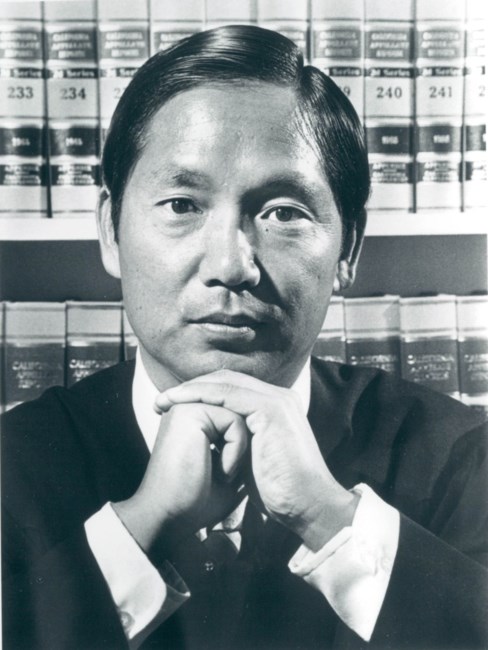
Retired Judge Harkjoon Paik, the first native-born Korean to become a Superior Court judge in U.S. History, died Friday night at his Carmel Valley home after a long illness. He was 79. Harkjoon was born Nov. 3, 1936, in Seoul, Korea.
During the brutal tumult of the Korean War, the teenaged Harkjoon became separated from his parents for about a year, during which time he wandered the country, fending for himself and staying away from the front lines. Seoul changed hands four times during the war. At the age of 15, he was finally reunited with his parents, whose home had been destroyed along with the father’s medical clinic. With the war still raging, they sent the young Harkjoon, who spoke very little English, to Monterey, where his brother was teaching at the Defense Language Institute.
Harkjoon lived and worked at a ranch deep in Carmel Valley and attended Monterey High. He learned English quickly and soon won a speech contest in his adopted language. Following high school Harkjoon attended Monterey Peninsula College for one year, and used a speech contest scholarship from the Lions Club to attend Stanford University.Paik earned a degree in history from Stanford in 1958 and his law degree from Stanford Law School in 1961. He put himself through his undergraduate and law school years, in part by washing dishes.
In 1958, he married Beverly Johnson, a fellow Stanford student, born to parents of Swedish descent. The marriage disturbed both sets of parents, but, over time, they came around.
After passing the bar, Paik was hired by the U.S. Department of Justice, where he worked in its anti-trust division in Los Angeles. However, realizing his heart was in the courtroom, he left to become a deputy public defender in Los Angeles County. He later took a similar position in Ventura County.
In 1969, Paik was hired as the first public defender in the history of Monterey County. He assembled a bevy of excellent attorneys, establishing an office both widely respected and remarkably skilled. It included several future judges. Gov. Jerry Brown appointed him to the Superior Court bench in 1975.
Judge Paik expected lawyers to be prepared from the moment they walked into his courtroom. He was exacting and demanding but also fair. He developed a reputation for not wasting time in the courtroom. More than one attorney stayed up all night to ensure readiness before venturing into Judge Paik’s courtroom. He was known for his dry and razor-sharp wit, both inside and outside the courtroom.
Judge Paik presided over many significant cases, experiencing and rebuffing pressure from the public in more than one high-profile case, before retiring in 1997. While on the bench, he also served as associate justice pro-tem of the California Supreme Court. He was the co-author of a litigation manual for state judges.
When Judge Paik retired, he said that he expected to slow down. But within a year or two he began receiving numerous requests to mediate civil matters. He worked as an independent mediator for the next 15 years, traveling throughout California to resolve often hoary disputes.
Judge Paik faced and overcame discrimination and racism on more than once in his life. At Stanford a counselor once told him that he should consider becoming a repairman or salesman. After he obtained his law degree, one law firm expressed interest in him but suggested that he change his name from Harkjoon to Harry. The interview ended.
“Have I experienced discrimination? You know, I’m sure I have,” he said in an interview in the Salinas Californian in 1993. “But I haven’t really given it much thought because I don’t have time to think about it.”
Judge Paik had a great joy in and love of life and an unyielding enthusiasm and gusto. “People ask me why I am always happy,” he once told a newspaper reporter. “I say, ‘Why not.’ So many people here take things for granted. Immigrants don’t. We are grateful for the opportunity. We know how to count our blessings.”
Judge Paik enjoyed bicycling on Carmel Valley Road and playing tennis. He and his wife traveled widely.
Mrs. Paik detailed her husband’s remarkable life in her work “Tracking the Tiger: The Story of Harkjoon Paik,” which was published in 2001. Written in his voice, it was based in part on the diaries he had kept.
In addition to Beverly, his wife of 58 years, Judge Paik is survived by two sons, Christopher (Joela) of Bethesda, Md., and Randy, of Santa Monica, and a daughter Lisa (James) Ballantine of Santa Barbara. He is also survived by a brother, Harkmoon (Taihi) Paik, of Monterey, and a sister, Sanok Kim, of St. Louis, Mo.; two grandchildren, Jackson Ballantine and Katherine Paik, and many nieces and nephews.
A Celebration of Life for Retired Judge Harkjoon Paik will take place next Saturday, November 12 from 3:00 pm – 5:00 pm. Friends are invited to call 831-659-4103 for more information..
Arrangements under the direction of The Paul Mortuary, Pacific Grove, CA.
Muestre su apoyo
Comparta Un Recuerdo
Comparta
Un Obituario
Obtenga actualizaciones
Servicios
COMPARTA UN OBITUARIOCOMPARTA
- RECIBIR RECORDATORIOS
v.1.18.0