
OBITUARIO
Charles August Bauer
27 julio, 1922 – 20 julio, 2017
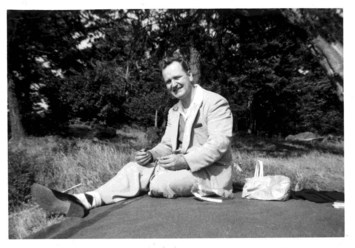
Charles August Bauer, Jr. (“Chuck”) was born in New Orleans, Louisiana in July, 1922, the middle child of Charles Sr. and Florence Collette. He passed away in July, 2017. Chuck’s father was the Chief Statistician for the Southern Pine Association, who as such had to travel extensively to Washington, D.C. and other cities. Chuck admired his dad, and spoke later of how hard his dad worked. Of his days growing up, Chuck spoke fondly about riding his bicycle with his friends all over New Orleans and swimming all summer in the big outdoor pool at nearby Audubon Park.
At about age 12 Charles took up residence and schooling at Holy Cross, a local Catholic boarding school for boys. In high school at Holy Cross, Chuck played on the football team; he greatly enjoyed watching and attending football games for the rest of his life. In 1940 after high school Chuck enlisted in the United States Marine Corps. After “boot camp” he was assigned to the Marine Corps guard contingent at the Bremerton Naval Yard near Seattle, WA. This duty included going on Navy gunboats such as the USS Charleston out on long patrols from Seattle to the Aleutian Islands and other parts of Alaska. It was during this time in the Seattle area that Chuck was introduced to University of Washington Huskies football, of which he was a fan for the remainder of his days.
In June, 1942 Chuck was transported with fellow Marines in the 22nd Marine Regiment to the island of British Samoa (now called Western Samoa) to perform island defense and to undergo training in jungle warfare in preparation for upcoming WW II island battles in the Pacific. Chuck was spared from actual battle, however, because he suffered a “grand mal” (severe) epileptic seizure. He was sent to California to recover and was medically (and honorably) discharged from the Marine Corps on September 22, 1943. He returned to New Orleans and became an apprentice at an optical shop where he learned the exacting skills needed to be an optician, a job in which he ground and shaped lenses for eyeglasses according to precise specifications as prescribed by optometrists.
“The last Saturday of June, 1946” was how Chuck referred to the day that was the big turning point of his life. He was cutting the grass when down the sidewalk came George Spyker, a buddy he had met in the Marines who was from a nearby Louisiana town. George took the mower out of Chuck’s hands and said, “Here Charlie, let me do that for you.” After a while George stopped and said, “You know Charlie, what you need is Jesus Christ.” George pulled a small Bible from his back pocket, where he used to carry a bottle of liquor. George started to tell Chuck about how the Lord had changed his life.
Chuck wanted to hear more; up until then he had only thought of Jesus Christ as a figure hanging on the wall of a church. They went inside to Chuck’s room, where they talked some more and George showed Chuck some passages in the Bible. Chuck felt God strongly speaking to his heart, and he got on his knees beside his bed. As Chuck told it, in his mind’s eye that figure of Jesus on the cross suddenly came alive to him and he prayed simply, “God, I believe You died to save a man like me. I don’t know what you want me to do, but whatever it is, I’ll do it.” Chuck said of that moment that he immediately felt like “something came into me and something went out of me.” That day, Chuck said, was the beginning of his life-long walk with the Lord. He began reading the Bible to see how God wanted him to lead his life, and in him developed a hunger to read and study God’s Word that stayed with him for the rest of his life.
An interesting side note is that Chuck believed God gave him some bonus blessings (“lagniappe” as they say in New Orleans). Although Chuck had several smaller epileptic incidents when he was younger (and then the big seizure in the Marine Corps), he never again had another one. Chuck later said he believed that part of the feeling he had of “something going out of him” was God healing him of epilepsy. Also, he had been a heavy cigarette smoker since his mid-teens, and he was able to kick that habit quite quickly and easily. And, all his life until then he had a bad stuttering problem; Chuck felt that God healed him of that also.
After going west with some traveling evangelists who had befriended him, Chuck felt that he should have some formal education. In 1948 he enrolled in Simpson Bible Institute, which at that time was in Seattle. During his time there Chuck would regularly go downtown with other young men from Simpson to do some “street preaching.” He no doubt had some interesting experiences doing this, and one that he talked about was that as he was on a street corner one evening preaching and handing out Gospel tracts a tough-looking guy came up close to Chuck and said, “What would you do if I stuck a knife in you right now?” Chuck just smiled, reached out and playfully pinched the man’s cheek and said, “You wouldn’t do that to me, now would you?” The man stared in surprise at Chuck, and finally said, “Here, gimme one of those things,” and he took a tract and walked away.
It was during Chuck’s time at Simpson that he first met Violet Birkeland (“Vi”), a Simpson student from Kent, Washington. Chuck graduated from Simpson in 1951, and he connected again with the traveling evangelists for a while. He kept in occasional written contact with Violet and ended up in Tacoma, WA, where he got a job as an optician. He was able to move on to a job with a bigger company, the Tacoma branch of American Optical Company (A.O.).
Meanwhile, romance with Violet bloomed; they were married in September, 1954 and they bought a small house in Tacoma. Chuck liked to talk about how much he appreciated Vi and what a big help and companion she was to him throughout their lives together. He always said he was thankful to God for Vi. Their tenderness with and love for each other was obvious, genuine and permanent. Chuck called her “Sunshine,” and Vi called him “Prince Charles.”
In 1961 Chuck was transferred to the Seattle branch of A.O., and Chuck and Vi decided to have a bigger house built for them closer to Seattle on land given to them by Vi’s mother, on the forested hill just above Vi’s childhood home, north and west of Kent. They moved into the new house in July, 1964.
Chuck enjoyed a long retirement, beginning in 1982, and for most of it he was in remarkably good health. He had always enjoyed reading and studying the Bible, as well as reading books on various other subjects that interested him. He was able to do even more of this in retirement. He really enjoyed getting together with others to read and discuss the Bible and sing songs. For quite a few years he wrote monthly letters and sent them to some friends and family members. In these letters he laid out his thoughts and views on a variety of Biblical subjects. Chuck truly was a Bible “scholar;” he devoted a lot of time, effort and thought to it.
Chuck had a life-long love of the beauty of the outdoors. In his younger days as a father he liked to take the family on camping and hiking trips, as well as to Point Defiance and Woodland parks. For a time, Chuck and Vi were in a club that went on nature walks at various places. Of course Chuck continued to closely follow Husky football, and was able to attend quite a few games with his sons over the years.
Chuck will be remembered by those who knew him as a man with so very many of the highest qualities of character and temperament. His life was an open book and a living example of integrity and honor. Yet he was self-effacing and a man of genuine humility and humbleness; he didn’t brag about himself, he didn’t think he was anything special, and he said he owed all the thanks to God for whatever good happened to him in his life. He was scrupulously honest, open and fair, a man without guile or deceit. Because of his close walk with God he had a child-like innocence about him.
He was straightforward, direct and unpretentious in his dealings with all people. You always knew where Chuck stood on any matter at hand; he didn’t deal in hidden agendas or ulterior motives.
Chuck was a hard-working, responsible and faithful husband, father,
grandfather and friend. He had a sweetness and gentle kindness of spirit that people noticed, even those meeting him for the first time. He greeted visitors with a warm smile and a genuine welcome. He was happy for the successes and good fortune of others, and he empathized with the troubles of others and gave freely of himself to help and/or encourage those who needed it.
Chuck was preceded in death by his sisters Mary Rita and Virginia Kay, and is survived by his wife, four sons, six grandchildren, and several nieces and nephews. Donations in Chuck's honor may be made to your local VFW chapter (Veterans of Foreign Wars).
Charles August Bauer was a special man, all the more so because he honestly didn’t know how special he was. Those of us close to Chuck miss him a lot and feel a large hole left by his passing. But we take comfort in remembering him and the exemplary life he led, and in knowing that God is faithful to receive and reward those who are faithful to Him, as Chuck certainly was.
Arrangements under the direction of Forest Lawn Funeral Home, Seattle, WA.
Muestre su apoyo
Comparta Un Recuerdo
Comparta
Un Obituario
Obtenga actualizaciones
Servicios
COMPARTA UN OBITUARIOCOMPARTA
- RECIBIR RECORDATORIOS
v.1.18.0