
AVIS DE DÉCÈS
Lewis Charles Lemon
16 juin 1926 – 4 juillet 2021
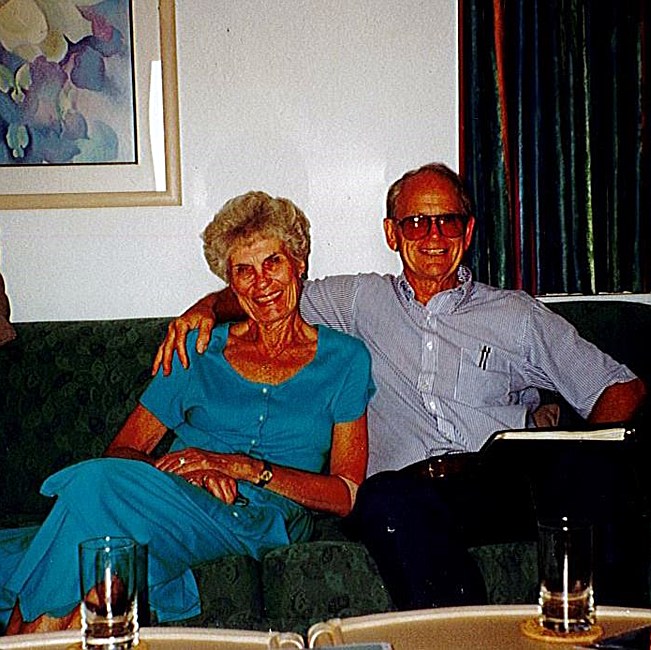
Good day to you all. One reason it's good is because we've gathered to celebrate the successful life of one of our fellow humans; Lewis Charles Lemon. The most immediate indicator of his success is the presence of so many people who liked him enough to take time out of their day.
Lewis Lemon, a card-carrying member of the Greatest Generation, fully embraced the American Dream and climbed his ladder to success with almost no outside help. He was born on June 16, 1926, in a tent on an oil field in Garfield County, Oklahoma, just south of the Oklahoma - Kansas border. He was the second of three boys. Two sisters were born, only one surviving child birth. His father, Roy, married Verona Ford around 1920. His father held many jobs including roughnecking, selling cattle, running a small store / gas station, and Lewis suspected he hauled loads for bootleggers more than once. My dad recently told me he’d felt guilty all his life of causing his father’s bankruptcy. Raised to be stoic, at age 8, he concealed several days of worsening abdominal pain. He feared being punished, and he had to faint before his dad found out. The appendicitis he’d endured progressed such that his intestine perforated, necessitating a couple weeks of hospitalization. With no spare cash, his father had to pay the doctor’s bill with barter, for food and gasoline, and with such a razor thin profit margin, the surgeon’s fees caused the business to fail.
As a child, a typical day consisted of arousal at 5 a.m., then chores: milk cows, slop pigs, feed chickens, etc. Breakfast at 6:30 was always filling, rarely healthy. School was over at lunch time and he and his brothers entertained themselves, along with their friends, with exclusively outdoors and unsupervised recreation. He mentioned swimming holes and fishing as favorites. He said, “we were always poor but never went hungry.”
His performance as a student was unremarkable. In high school, he played basketball and football. During his time in high school, World War II started, and the multiple industries mobilizing for war spurred a hugely increased demand in certain trades and job fields, including installing pipelines for oil transport. He left high school midway through his junior year with a friend who had heard about pipeline jobs, and had a car, and traveled to Pennsylvania, later Ohio, Illinois, and Arkansas, wherever the jobs took them.
Unskilled, but apparently applying enough bravado, he was hired as a gasoline / diesel fuel delivery driver. He told a story of talking his way into a promotion as a tractor operator despite lacking any experience. Soon afterward, that same bravado almost did him in. He was leveling a stretch of scraped soil to ready it for asphalting. The tractor abruptly stopped; he backed up, gunned it, and tried it again, same result. Expecting to find a large stone, he found that the tractor blade was abutting against a buried concrete sewer pipe, which hadn't yet broken. That was the moment when he began his belief in a merciful god.
Entranced by his ability to support himself and save enough money to buy a car, he worked for a year-and-a-half, then felt confident enough to ask his boss for a raise. The boss had gotten to know Lew well, due to the long stretches spent together as Lew was driving his boss to inspect different work sites. He was told” I won't give you a raise, but I WILL fire you if you don't go back to college”. Not yet prepared for that, Lew enlisted in the Army for the last 2 years of WW II, unaware that the GI Bill would become law shortly after the end of hostilities.
That made college possible, but immediately there was a roadblock: he lacked a high school diploma. Returning to his hometown high school, he told the truth to the principal. Unknown how, but he soon had his diploma and entered Oklahoma A and M. He had a hard labor, 8-hour day job to pay for his room and board. His tasks included hauling 90 lb. bags of concrete upstairs and over ditches, hauling 100-lb loads of bricks, and employing pickaxe and shovel to finish trenches for pipes.
After somehow finishing college, Lew was commissioned as an officer in the newly - created U.S. Air Force, knowing that he’d be treated much better and have an overall better life being an officer. He was assigned to electronics school and with no math background was able to graduate. His first duty station was to supervise an electronics repair and inspection division at Amarillo, Texas. We assume he must have been happy when he met another newly-minted Officer, the same rank as him but whom he would be in charge of. This was Lieutenant Barbara Lombard and she was tasked with supervising the secretarial / stenography airmen. We never heard any details but they were married within a year of her arrival.
Their first child arrived six months after Barbara was forced to resign from the Air Force, pregnancy being a condition which might hinder a soldier's ability to wage combat. Tachikawa Air Force Base, constructed several years after World War II, was raw and unfinished when they arrived. They had to live off base since no on-base housing yet existed, and the house walls were made of split reeds and rice paper. Their house had no insulation or air conditioning, but did have a wooden floor. Son number two arrived several months after their arrival to Japan; the third, 15 months after that.
His next assignment was to last 3 years, also in electronics, at Tyndall AFB, Panama City, Florida, after which he was selected for Advanced Training for master's degree in Systems Management at the prestigious George Washington University in Washington D.C. During his time in Washington, D.C, a fourth son was born into the family. Then, three more years at MacDill AFB in Tampa, Florida and then the inevitable Vietnam assignment that was only one year duration due to being a war zone. He was in charge of missile loading safety and did well enough reducing accidents to earn a Bronze Star and the Air Force Commendation Medal. He leveraged several of his superior’s favorable Impressions to arrange a state-side assignment to Norton Air Force base near Redlands, the longtime hometown of Barbara's family, the Lombard’s.
There, he joined the Inspector General of the Air Force, a position requiring frequent travel both national and international. He busied himself in his spare time with repairs and improvements to the 74-year-old home they bought on Highland Avenue. All the boys were expected to do a couple of hours of chores on the weekends. On the tasks he didn't already know about he bought and read many how to books.
After five years at Norton Air Force Base, and now eligible for his Air Force pension, he resigned and worked another thirteen years as a traveling registrar - counselor for USC's master's degree program in systems management, more than doubling the number of students by his third year.
Retirement brought enough time and money to allow several vacations per year: to England, Spain, Hawaii, and their favorite spot, the Gulf Coast of Florida where he eventually bought two oceanfront condos.
Preceded in death by Barbara, his last 14 years were occupied with home maintenance, joining an oldies band as keyboardist, and continued loyal attendance and support for Trinity Episcopal Church.
His last two years were fraught with multiple illnesses which understandably depressed him but did not destroy him nor, until the end, his will to live. He will be remembered as a generous, sociable guy who in many ways served as an exemplary example to his boys and his friends. He died peacefully, pain-free, surrounded by Family on Independence Day.
Our family wants to again thank you for your remembrance, and your support.
Montrez votre soutien
Envoyez Vos
Condoléances
Partager
L'avis De Décès
Obtenir les mises à jour
Prestations de Service
Partager l'avis de décèsPARTAGER
- RECEVOIR DES RAPPELS
v.1.18.0