
AVIS DE DÉCÈS
Mr. Les Kirkpatrick
19 octobre 1916 – 27 janvier 2010
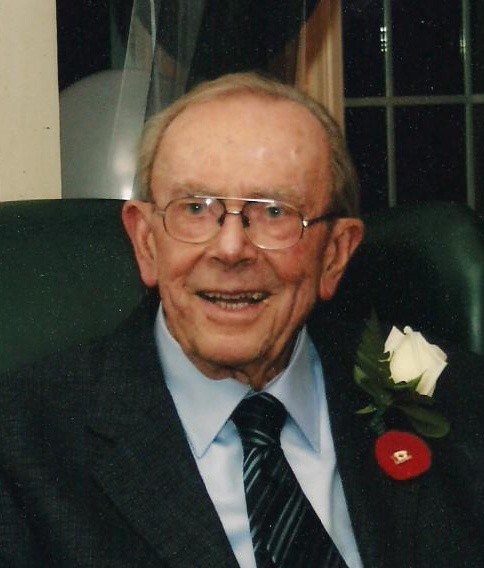
Lesmere Forrest "Les"
93 years, Halifax
KIRKPATRICK, Major Lesmere Forrest "Les"
— (DSO, P.Eng., D.Eng., FEIC) It is with the greatest sadness that we announce the passing of a great Nova Scotian. Les Kirkpatrick, age 93, died on January 27, 2010, at Veterans' Memorial Hospital, QEII, Halifax. Predeceased by his beloved wife of 51 years, Eva Katherine Gavin; his daughter, Mary Leslie; stepbrothers, Charles and Fred Dyas. Les will be remembered with pride and love by his surviving daughter, Kathie and husband, Peter Falkenham, Lunenburg; grandchildren, Nicholas and Andrew. Les is also survived by his sister, Sylvia Sinn, Lennoxville, QC.; stepsister, Elizabeth Anthony, Halifax; special nieces, nephews and dear friend, Shirley Robertson. After a long life that was marked by integrity, great accomplishment and bravery in the uniform of his country in war and in the service of the people of Nova Scotia in peace Les will best be remembered as a pivotal figure in the history of Nova Scotia's energy industry. As President and General Manager of the Nova Scotia Power Commission in what he always called the "dirty 70s", Les was at the centre of the firestorm that erupted in 1972 when the government of Hon. Gerald A. Regan decided to establish a single, publicly owned power utility in the province. Achieving that crucial public policy goal meant taking over the privately owned Nova Scotia Light and Power Company, a move that enraged the business establishment of Nova Scotia. Les, with the same courage as he showed as a Canadian Army Officer during the Second World War, strongly asserted that Nova Scotia's future economic development, and good electric service to all provincial communities, could only be achieved by the establishment of one electric utility for the entire province, and he fought as hard for that controversial end as he did against the Nazi armies in Europe following D-Day. Born in Advocate Harbour in 1916, les's family moved to Parrsboro when he was nine years old. He was the son of Rupert Edwin and Vera Lavinia (Ward). His father and grandfather were major players in both the lumbering and wooden ship building businesses. Les was educated in the school system of Parrsboro before proceeding to Mount Allison Unviersity where he received his certificate in engineering. He then went to the Technical University of Nova Scotia (TUNS) and, in 1936, graduated with a Bachelor's degree in mechanical engineering. Les returned to Parrsboro to become Superintendent of its Municipal System from 1938 to 1940. Like so many young men of his generation, Les' life was changed forever by the Second World War. He joined the armed forces in 1940 and served, first, on the home front in the Coastal Defence Service in Halifax Fortress and Newfoundland. By 1943, he had shipped out to England where he served with Anti-tank Weapons and Development Research at Canadian Military Headquarters (CMHQ) in London, England. Six days after D-Day, Les landed on the shores of Normandy with the Third Canadian Infantry Division, the main Canadian Division that had landed on Juno Beach on June 6, 1944. This division consisted mostly of the Winnipeg Rifles and the Regina Rifles regiments. From his arrival in France until the end of the war, Les had one of the toughest and most dangerous jobs in the army, he was a Forward Observation Officer (or a "FOO"). To be a "FOO" meant taking up positions well forward of the battle lines. From that dangerous location, the "FOO" directed artillery fire from the allied guns, usually from positions on taller building or hilltops where a "FOO" was always a prime target for German snipers. To play that role properly, a "FOO" had to be both brave and dedicated. Les was both. His hazardous army job and the distinction with which he fulfilled it were recognized after the allied breakout on the Rhine in February and March of 1945. For his bravery, particularly during those final days of war on the western front, Les received the Distinguished Service Order. He was supposed to have received this high honour at the hand of King George VI at Buckingham Palace in late 1945 but Les chose to return to Canada with his regiment so he could be with his family in Nova Scotia for the Christmas of 1945. He made it back a week before Christmas. In early 1946, Les received his DSO at Government House in Halifax where Hon. J. A. D. McCurdy oversaw the investiture. After being demobbed from the Army, Les became a construction and design engineer with Canada Electric Co. Ltd. in Amherst where his first job was to bring power to the village of Advocate Harbour, his birthplace. After nine years with that firm, Les became Commercial Superintendent of the Nova Scotia Power Commission and, then, in the fateful years of 1972, he became General Manager of the Nova Scotia Power Commission, the province's publicly owned power utility. After the emotional takeover of Nova Scotia Light and Power, Les, in 1973, assumed the mantle of President and
General Manager of the newly formed Nova Scotia Power Corporation (NSPC). In 1978, Les became President and Chairman of NSPC before, in 1980, being appointed President and Chief Executive Officer, and simultaneously made a Director of NSPC. Like his dangerous and exposed years during the war, Les had to endure both the oil shocks of 1973 and 1979 when the issue of the cost of electricity became the key issue that played a major part in the defeat of Gerald Regan's government in 1978. Les always referred to the 70s as "the worst period of my experience" but he navigated his way through these challenging years with his characteristic fortitude while always maintaining a modest low profile. Always forward-looking, and as a "son of the Bay of Fundy", Les was a pioneer in studying and preparing for the possibility of tidal power in Nova Scotia. From 1978 to 1987, he was vice president and a director Nova Scotia Tidal Power Corporation. Although tidal power did not become a reality on Les's watch, no one was more pleased with the positioning of powerful new tidal power-generating turbines in the Bay of Fundy in 2009 than Les. He was also an early advocate of nuclear power for Nova Scotia, an idea that will gain more prominence as climate change evolves in the 21st century. Throughout his long and distinguished life, Les always kept a strong connection with his beloved TUNS. He was awarded an honorary doctorate in engineering by TUNS in 1973 and then went on to serve as a member of the University's Board of Governors from 1985 to 1996. He was named chairman of TUNS national fund-raising campaign in 1982. In 1972, his colleagues in the engineering profession awarded Les the F. H. Sexton Medal. He was a founding member and director of the Canadian Academy of Engineering and, for many years, was a member of the Board of the Canadian Electrical Association. In 1993, Les became an honorary life member of the Association of Professional Engineers of Nova Scotia He was on the Board of Saint Mary's University from 1980 to 1985. On his retirement, Les became an energy consultant to the Royal Bank of Canada. He also became active in health care and became Chairman of the Board of Blue Cross. He was also proud, for 20 years, to have been Chief Warden of Camp Seven of the Corporation of Seven Wardens, the body that oversees the awarding of iron rings to graduating engineers. In 2009, Les was presented with a 70 year bar from Masonic Lodge, Minas No. 67. Les served on the Boards of Atlantic Mutual Life, the Public Service Commission of Halifax (where he was also the chairman), the Atlantic Provinces Economic Council, the Royal United Services Institute, the Halifax YMCA, the Halifax Board of Trade, The Canadian Nuclear Association, the Halifax Club and the Advisory Board to the Sisters of Charity and St. Vincent de Paul Society. In his busy life, Les also managed to become a good club tennis player and a respectable golfer. He was a passionate fly fisherman and frequently fished the rivers of northern New Brunswick and Newfoundland in search of the noble salmon. In everything he did, Les was always an able, determined player and a keen competitor while, simultaneously and at all times, remaining a perfect gentleman. In 1985, Les underwent a heart bypass operation and, soon after that, and for the next 20 years, was the proud chairman of the Open Heart Patients Support Group in Halifax. Arrangements have been entrusted to J. A. Snow Funeral Home, 339 Lacewood Dr., Halifax, where visiting hours for Les will be held today from 7-9 p.m. A funeral service will be held on Saturday, January 30 in Bethany United Church, Halifax at 2 p.m. Interment will take place in Parrsboro at a later date. In lieu of flowers, donations may be made in Les's name to Maritime Heart Centre, Camp Hill Veterans' Memorial Garden Fund, Camp Hill Veterans' Memorial Building, QEII or a charity of your choice. On-line condolences may be made to: www.MeM.com. Les' life can best be appreciated by a quotation from the final paragraph of his citation for the DSO in 1945:
"Major Kirkpatrick has pursued his duties with the utmost energy, devotion and efficiency to the complete disregard of his own personal safety, with a result that the infantry whom he supported never entered into operations without the utmost confidence in their ultimate success and the supporting Artillery fire. Thus were the best traditions of the Royal Canadian Artillery exemplified by the actions of this officer."
That says it all.
"Rest In Peace Les"
Montrez votre soutien
Envoyez Vos
Condoléances
Partager
L'avis De Décès
Obtenir les mises à jour
Prestations de Service
Partager l'avis de décèsPARTAGER
- RECEVOIR DES RAPPELS
v.1.18.0