AVIS DE DÉCÈS
Abdelmalak E. Morcos
2 janvier 1933 – 3 septembre 2022
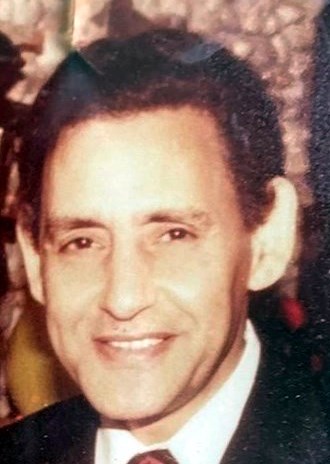
The physician Abdelmalak E. Morcos died on September 3, 2022 due to complications from Covid pneumonia. He was 89-years-old. The Funeral will be held on Thursday, September 8 at 10 am at St. John the Beloved and St. Mary Magdalene Coptic Orthodox Church, 270 Whippany Road, Whippany, NJ 07981. The Burial will be held at Rosehill Cemetery, 64 Coptic Church Section, Grave #461, 792 Edgar Road, Linden, NJ 07036. There will be an Agape Feast after the burial.
Abdelmalak Elkomos Morcos was born on November 21, 1932 in southern Egypt, in the village of Negada. The date of his birth is the same day as the Feast of the Synaxis of the Holy Archangels, on the Old Calendar of the Egyptian Coptic Orthodox Church. This is why his father, the Archpriest Morcos, named him “Abdelmalak,” which means “the servant of the angel” in Arabic.
The priesthood was integral to the Morcos family. The Archpriest Morcos had four brothers who were all priests. The grandfather of Dr. Morcos, the Archpriest Yacoub [Jacob], was a (married) father confessor to the monks of The Monastery of the Holy Cross in Negada. And Dr. Morcos’s brother, the late Archpriest Abdelmasseh [“the servant of Christ”], was revered in all of Egypt’s Coptic churches, as well as the diaspora, as the foremost chanter of his generation.
As a young child, Dr. Morcos’s father moved the family to Luxor, Egypt where he built the Church of St. Mary, which still stands and is located only a few miles from the famed ancient Temple of Karnak. Fr. Morcos served as senior priest there for more than 30 years. Dr. Morcos’s mother, Nasira, had a ministry of her own, converting her home into a soup kitchen once a week. (The parsonage of the Morcos family was recently torn down by the Egyptian government in order to excavate tombs from the Pharaonic era.).
Dr. Morcos attended primary and secondary schools that were run by American Protestant missionaries in Luxor. The curriculum was conducted in English so the young Abdelmalak learned to speak English fluently. He attended medical school at Ain Shams University and began practicing as a physician of internal medicine in Cairo.
In 1958, he married his first cousin, Souad Faheem Shehata, a high school science teacher. The couple settled in the Shubra section of Cairo, which was heavily populated with Coptic Christians.
Dr. Morcos was soon drafted into the Egyptian Army and served as a physician in two wars: the Yemen Civil War (1962 – 1964), which is widely considered to be Egypt’s “Vietnam,” and the Six Day War (June 1967), which was fought against the State of Israel. The Six Day War was a stinging defeat for the Egyptian Army and Dr. Morcos would often reminisce in detail about his experience of both wars.
Upon his return to Cairo following the Six Day War, Dr. Morcos was informed by his superiors that he would be stationed in a remote desert town. He attributed this to discrimination on the basis of being a Coptic Christian in a country that was majority Muslim. He made his decision then to leave Egypt permanently.
One night, Dr. Morcos was listening to a broadcast of the BBC World Service which reported that there was a shortage of physicians in the United States because so many had been dispatched to Vietnam. He successfully applied for immigration to the United States and the Morcos family moved there in 1969.
Before he could practice medicine in the United States, Dr. Morcos had to pass a very challenging two-day medical exam known as the ECFMG, which was compulsory for all foreign-trained medical doctors. He studied for the exam in the night while holding down a fulltime job as a lab researcher in New York City. On the second try, he passed the exam.
Dr. Morcos practiced anesthesiology in several states including New York, Missouri, Kansas and Pennsylvania. As a physician, he was known for his pleasant bedside manner and consideration for his patients. He would visit his patients the night before surgery and explain in detail what they should expect.
He considered himself a “political junkie” and would devour the political news sections of The New York Times. He loved to watch MSNBC and often railed against very conservative politicians. Later in life, he returned to the Coptic Church and became a very dedicated parishioner. He would often say that the Coptic Church had saved him from some life-long habits. He would read the New Testament late into the night and he especially relished the conversion story of the Apostle Paul. To his children -- and indeed, to anyone who would hear him -- he would constantly tell the story of how he convinced the late Coptic Patriarch, Shenouda II, to visit his wife, Souad, who was dying of breast cancer.
He is survived by his two children, Raouf and Amal.
Montrez votre soutien
Envoyez Vos
Condoléances
Partager
L'avis De Décès
Obtenir les mises à jour
Prestations de Service
Partager l'avis de décèsPARTAGER
- RECEVOIR DES RAPPELS
v.1.18.0