
OBITUARY
James Norton Krebs
April 20, 1924 – July 20, 2022
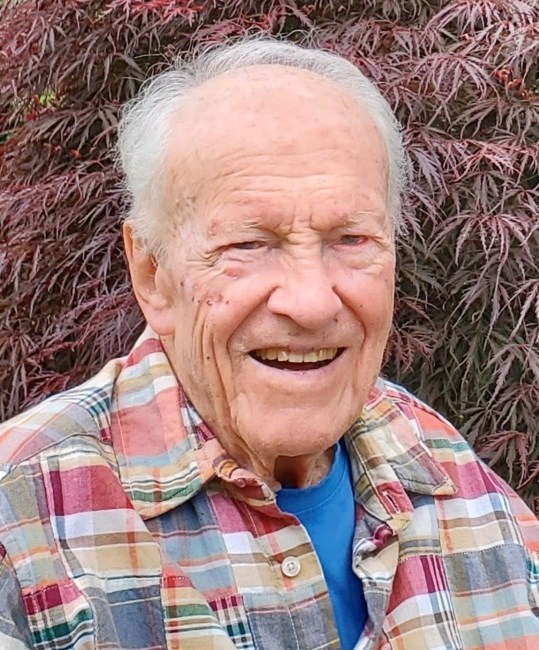
MARBLEHEAD - James Norton Krebs, a veteran of General Electric’s aircraft engine business and a big thinker who dreamed up the world’s most successful jet engine, died at home on July 20. He was 98 years old.
Mr. Krebs began working as a GE test engineer in 1946, four years after America’s first jet flight. He joined a group of aerospace visionaries who helped propel the world into the jet age, shrinking the globe forever. Mr. Krebs is best known for his work on the high-bypass turbofan, the quiet, powerful, fuel-efficient engine that is ubiquitous in the skies today.
Every two seconds, Mr. Krebs figured, a plane takes off with a GE engine bearing his design stamp, a reminder of an era when the United States was No. 1 in world aviation. In 1982, Mr. Krebs was elected to the National Academy of Engineering for his contributions to jet engine design and development. He retired from GE in 1985 after 39 years with the company.
“For the younger guys like myself, he was almost godlike,” said Lloyd Thompson, a retired GE jet design engineer who began working with my father in 1974. “He’s mythic in the history of GE aviation. He saw things before most people did. You could almost say he was a futurist."
Mr. Krebs was an engineer with an artist’s eye. He and his first wife, Mitch, spent a lifetime collecting the works of contemporary artists and photographers, including Native Americans in Santa Fe, where they retired part-time during 23 years. They contributed generously to the Museum of Fine Arts Boston and the Peabody Essex Museum in Salem, Mass. A few of their many donations of Native American textiles, paintings and clay pots are currently on view at the Peabody Essex exhibition, “On this Ground: Being and Belonging in America.”
Mr. Krebs was a skilled photographer himself, moving with ease from black-and-white prints at age 14 — prints that he developed in a chemical darkroom in his bedroom with a blanket over the window — to the full-color palette of digital Adobe PhotoShop in his later years. He shot excellent portraits and printed a decade-by-decade collection of color photos of his family of six — a revealing slice of American life as it was lived on the crest of the wave after World War II.
Mr. Krebs self-published Chinese Exposures, photography books on his six trips to China for GE in the 1980s, on the eve of the industrial revolution in that country; and Trekking in Tibet, about his 1990 trip in the foothills of Mt. Everest on the border with Nepal. Inspired by the British artist David Hockney, Mr. Krebs liked to make photo collages of public scenes, ranging from the swan boats at Boston Commons to Tibetan palaces, Native American dances and the pigeon ladies at Trafalgar Square in London.
As he grew older, Mr. Krebs focused his lens most frequently on Abbot Hall over Marblehead Harbor, traveling only as far as the porch of his harbor-side home of 65 years on the Neck. He was bowled over by the beauty of blazing sunsets, silvery moonrises, misty mornings and the mesmerizing comings and goings of people messing around in boats.
Early on, Mr. Krebs bought a Brutal Beast, graduating over time to a Tartan 34 named Innisfree that he used for cruising ‘downeast’ along the coast of Maine. He joined the Eastern Yacht Club and raced a series of boats on summer weekends. In his 80s and early 90s, he was the Ancient Mariner in an old lobster “picnic” boat. He had a love affair with Marblehead for life.
Cold War career
Mr. Krebs started at GE with a salary of $56.25 per week, paid in a small envelope with the change rattling around inside. He was 24 years old.
“I was on the ground floor of an exciting new business,” he said recently, remembering the freewheeling atmosphere of those early days at GE’s Flight Propulsion Division in Lynn, Mass.. “It was a super-good climate for creative work. You had to be curious, and you were encouraged to be bold.”
By the end of his career in 1985, Mr. Krebs was GE vice president of military and small commercial aircraft engines, and head of engineering and manufacturing operations for engines at GE’s River Works in Lynn, overseeing 10,000 employees and a $2 billion annual business. GE had vaulted to No. 1 in the marketplace for commercial and military planes.
Mr. Krebs was a significant player in the 40-year Cold War between the U.S. and the Soviet Union, as the rival superpowers faced off during the second half of the 20th century. He oversaw the development and production of the jet engines that powered such planes as the F-117 stealth fighter, B-1 bomber; Blackhawk, Seahawk and Apache helicopters; and the planning and design of a new family of engines for the C-5 Air Force transport, a giant cargo plane that was deployed to Vietnam, Iraq and Afghanistan.
GE’s project managers used to get what they called “Krebs-O-Grams” — single-spaced questions, tiny diagrams and ideas for consideration that he would squeeze into the margins of their weekly reports — before the invention of e-mail — and send back to them. The managers got so tired of having to respond that they enlarged the body of their reports so there would be no margins. Undeterred, Mr. Krebs shrank the reports on a photocopy machine to create even bigger margins.
“I hope Heaven is ready for Krebs-O-Grams,” a former colleague said this week.
The 737
As the commercial aircraft business began to take off and outstrip the military side, Mr. Krebs remained at the forefront. Beginning in the late 1960s, his team at GE built turbofan engines for the DC-10 and Boeing 747 “Jumbo Jet” and 767, and they became the planes most widely used for international flights.
One of Mr. Krebs's greatest accomplishments was to conceive the idea for and oversee the initial design of the engine for a midsized commercial plane -- what would later become the Boeing 737 in the U.S. and the Airbus 320 series in Europe. Mr. Krebs saw that the core of the F101, the engine on the B-1 bomber, could be modified to power such a plane. Under a joint venture begun in 1971 between GE and the French, more than 30,000 of these engines, known as the CFM56 family, have been sold, generating thousands of jobs and more than $1 trillion in business, a bonanza for the industry.
Mr. Krebs chafed at the 50-50 deal with the French and later called it GE’s “first outsourcing.” The engine was his team’s design and, he boasted, much superior to the “obsolete” version the French had brought to the table. Mr. Krebs was bothered all his life by what he viewed as a costly giveaway of U.S. manufacturing jobs for the country’s most lucrative jet engine ever.
In his retirement, Mr. Krebs became disillusioned as competition from Airbus killed off McDonnell Douglas and the European firm grew into a colossus with a market share that rivaled Boeing’s. Aerospace firms from Canada, Brazil and China began moving into sectors that Mr. Krebs believed America could and should have dominated.
“We must get our aerospace priorities straight!” he told Congress in 1991. “Let’s get America out of the doldrums!”
Staunch democrat
Mr. Krebs was born in 1924 in Sauk Centre, Minn. but spent most of his childhood in Duluth, Minn. and Quincy, Ill. He graduated from Northwestern University in 1945 with a B.S. in mechanical engineering and a commission as an Ensign in the U.S. Naval Reserve. He served briefly in the Pacific at the end of World War II but did not see combat.
In December 1945, Mr. Krebs married Margie “Mitch” Mitcheson, whom he had met in freshman English class in college. They raised four children and were together for 60 years. In 2006, following Mitch’s death, Mr. Krebs married Mimi May Nolte McClellan, a childhood friend from Duluth, Minn. who could put up with being awakened in the middle of the night to discuss carbon sequestration. She died in 2019.
For most of his life, Mr. Krebs was a registered Democrat, an anomaly in the top echelons of GE. He became increasingly disenchanted with the country’s misadventures abroad – wars in which bombers equipped with GE’s jet engines were being deployed. He believed in fair taxes for corporations and the rich, and he deplored the CEO mantra about “maximizing shareholder value.”
“CEOs must put their minds to building American jobs, too,” he would say. “Mere profitability, by itself, isn’t good enough.”
During the past 10 years, alarmed by the threat of catastrophic climate change, Mr. Krebs met repeatedly with GE engineers and fired off letters to the top brass at the company and NASA, urging them, sometimes in ALL CAPS, to re-imagine aviation, save fuel and reduce carbon emissions. He feared for the future of the very industry that he had helped forge into a powerhouse of the modern economy.
Mr. Krebs was a brilliant, optimistic, gracious man who set high standards but unfailingly sought to encourage those around him. He claimed never to have suffered confusion as a state of mind. “Write a list of pros and cons!” he would say. To us children, it seemed there was nothing our father couldn’t do, no problem he couldn’t solve. He smoothed the rough patches of our lives. We will miss his light heart forever.
Mr. Krebs is survived by his sister, Carolyn Dukes of Santa Barbara, Calif.; four children, Leslie, David, Stephen and Mark; and six grandchildren — Shane and Aurora Amaya and Sylvia, Nathan, Spencer and Natalie Krebs. A private memorial will be held in the fall. Fond memories and expressions of sympathy may be shared at www.EustisandCornellFuneralHome.com for the Krebs family.
— Leslie Krebs
Show your support
Add a Memory
Share Obituary
Get Reminders
Services
SHARE OBITUARYSHARE
- GET REMINDERS
v.1.18.0