
OBITUARY
Rosemary Parisa Miller
April 8, 1918 – January 12, 2013
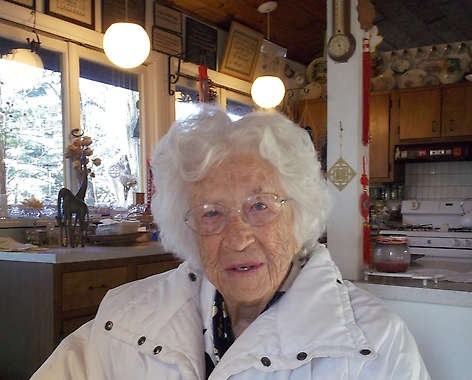
There were many times during Rosemary Miller’s life that she had a vision others just couldn’t see.
In the early 1980s, Judge E. Michael Hoff stood next to Miller as they both looked up through the roof of the historic Morgan House, straight through to the sky. Water dripped down from holes in the ceiling, and urine from the previous owner’s St. Bernards had peeled paint from the walls.
“The property looked like it should be razed or bulldozed to the ground,” Hoff said.
Miller, on the other hand, could not help but look up and smile. She saw an opportunity. She saw the framework for what is now a restored Queen Anne-style home that houses law offices.
As the co-founder of Bloomington Restorations Inc. and a key player in the histories of the city’s Historic Preservation Commission and Bloomington Area Arts Council, Miller helped shape what Bloomington is today. So, when members of the community heard Miller, 94, died in Annapolis, Md., Saturday, they couldn’t help but share stories about the vision this feisty woman had brought to the scenery around them.
For instance, she scaled the dome of the Monroe County Courthouse with Gayle Cook during an effort to preserve that landmark. The saving of the Princess Theater, the former Carnegie Library, the Paris Dunning House and the Daisy Garton farm are all credited to Miller.
“If Rosemary P. Miller got something on her mind, get out of the way,” said Evelyn Powers, who worked under Miller as campaign coordinator to raise funds for what would become the John Waldron Arts Center.
Powers remembers when she first met Miller at her home for an interview about the arts center project. The task was daunting: The city would allow them to have the building, if they could procure $750,000 in funding before the end of 1989.
It was June.
Miller’s house was filled with pieces of art from three-month excursions to South America and tribal masks from Africa. Her jewelry prominently featured sterling silver and turquoise stones. An accomplished painter, Miller had a keen eye for what she wanted: On a whim, she pulled over during a casual drive and bought an orange Honda Element from a local car dealership, just because the vehicle struck her the right way, Hoff recalls.
Before that, she drove a “land shark” station wagon to lunch dates downtown with her girlfriends. If you were wondering if it was her approaching from down the road, you needed only to see if a yellow fake sunflower was attached to the antenna.
Miller was a presence, and it was her ability to work the room that jump-started the arts center campaign. In desperate straits, Powers followed Miller to Herman B Wells’ home to see if the legendary Indiana University leader could lead them to their money. He could only hear out of his right ear, Powers said, but he reviewed the list with the two women.
“He’d say, ‘Good one. Good one. Don’t even bother with that one,’” Powers said.
Then, he mentioned Cecile Waldron.
“Do you mind if I call on her?” Miller asked. “Well, she’s old and I’m old, so we’ll get along good.”
After a chat with Miller, Waldron agreed to donated $375,000 over three years, which spurred the community to rally financially for its arts center.
When the Waldron Arts Center was established, a gallery was named after Miller. Miah Michaelsen, who currently works as arts director for the city, started out as the Miller Gallery’s director. Unlike many art collections, named after influential figures of the past, Miller was always around to tell those who put their art in her gallery what she thought of it.
“If it was a student or an established artist, it didn’t matter. She really dove in,” Michaelsen said of Miller’s critiques.
As she grew in years, she never relinquished her spirited personality. Steve Wyatt, executive director of Bloomington Restorations, remembers a party six or seven years ago when she ventured into a large swimming hole near the remnants of a limestone quarry behind someone’s house.
Nancy Hiestand, the head of Bloomington’s Historic Preservation Commission, remembers a drive with Miller to look at historic bridges in Clark County, becoming bored by a monotony of cornfields.
But Miller, with her eye, saw something much different.
“She noticed that when the wind blew one way, the field was one color and when they collapsed down it was another,” said Hiestand, who now notices that at one moment a field might be green, and, at another, it will shine silver. “What an incredible eye.”
In the Bloomington Herald April, 2012:
Rosemary Parisa Miller, 94, was born on April 8, 1918. She passed away on Saturday, January 12, 2013 in Annapolis, Maryland. Memorial Services are pending at this time but will be held at John Waldron Arts Center in Bloomington.
Rosemary grew up on a Kansas fruit farm near Lansing, where her father was also a county judge.
Active as a girl in 4-H, Rosemary won the Kansas Canning Championship and excelled in school, attending Kansas State.
While working on her master’s degree in art at Washington State in Pullman, she met Delbert C. Miller at the boarding house where they both lived and they soon married.
Rosemary and Delbert, a professor of sociology, lived in numerous places over the nearly 60 years of their marriage, including New York City; Washington, DC; Kent, Ohio; Seattle, Washington; Bristol, England; State College, Pa; and Lima, Peru.
In 1959 they moved with their two children, Michael and Trudy, to Bloomington. Rosemary still lives in the modern home she designed.
Her son Michael, a longtime professor of biology at the University of Cincinnati, is an active volunteer environmentalist. Daughter Trudy is the cofounder and chair of the board of one of the country’s largest nonprofit developers of affordable housing and is active in civic affairs in her hometown of Annapolis, Md. Rosemary’s husband Delbert is deceased.
Rosemary and Delbert loved to travel and visited hundreds of countries around the world, always in adventuresome ways.
In 1954-55 the family toured Europe by bike, traveling more than 3,500 miles with their children ages 10 and 11 and staying in youth hostels.
The couple, among many adventures, tent-camped alone in African game parks and shot the rapids in the Grand Canyon.
Rosemary was an artist her whole adult life and for many years managed the IU Craft Shop, teaching a wide variety of crafts.
A prolific painter, she has painted extensively of her travels and has had several shows of her work in Bloomington.
A patron of the arts, she was instrumental in the creation of the John Waldron Arts Center, serving on the board and securing the largest donation from Mrs. Waldron; the Rosemary P. Miller Gallery there is named in her honor.
Rosemary is probably best known in Bloomington for her contributions to historic preservation.
She helped preserve many important structures in town, such as the Courthouse, the Paris Dunning house, the old library and the Buskirk Chumley Theater.
She founded Bloomington Restorations and served for decades on the boards of that organization and the Bloomington Historic Preservation Committee.
Show your support
Send Flowers
Add a Memory
Share Obituary
Get Reminders
Memorial Services (Pending)
- SEND FLOWERSSEND
FLOWERS SHARE OBITUARYSHARE
- GET REMINDERS
v.1.18.0