
OBITUARY
Franklin & Virginia Osgood
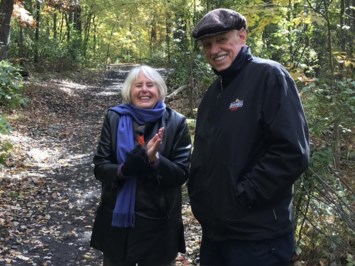
Franklin and Virginia Osgood passed away quietly in their sleep within twenty-four hours of one another, lying beside each other to the end. It was a fitting testament to sixty-six years of love, friendship, and devotion.
Their relationship began, as so many great love stories do, with an intoxicated Naval officer pounding on the door of a college sorority asking for a date, any date.
Frank was a young pilot fresh out of flight school. “Ginny” was barely out of high school herself. She had been at the University of Rhode Island for scarcely a month when the unruly aviator appeared at her sorority house loud, well-lubricated, and, in Ginny’s telling, more than a little obnoxious. His uninvited arrival at a residence full of freshman girls alarmed the house mother, who summoned Ginny to escort him from the premises.
“What shall we do with a drunken sailor?” asks the old Irish song. Agree to a date the following evening, Ginny answered
Two years later, Frank dropped to one knee, presented his mother’s diamond ring, and proposed.
When they first met in the autumn of 1959, the two seemed an unlikely match. Ginny was cultured, disciplined, and worldly — a self-described “Army brat” who had traveled the world, spending her childhood moving from one military post to another. Frank was a working-class kid from Manchester, New Hampshire, who had scarcely left the state before joining the Navy in 1958. Ginny had been taught to sip scotch, eat exotic foods, and use the proper cutlery. Frank ate Spam from the can.
Yet both understood something about hardship, separation, sacrifice, and duty.
Franklin Baker Osgood was born in Manchester on July 12, 1937. When he was six years old, his father, John Kenneth Osgood, was diagnosed with tuberculosis and quarantined in a sanitarium. Frank’s last memory of his dad was of a man standing at a window, waving down to his son below. They never had the chance to say goodbye.
Frank thereafter was raised alone by his mother, Mary Osgood. Money was scarce in the household, but love was abundant. By all accounts, Mary Osgood was love incarnate. To support young “Baker,” as Frank was known in childhood, she sewed buttons onto sweaters at a mill along the Merrimack River — grueling labor that paid only pennies per button. She worked punishing hours to provide even the most modest meals for her son. As a boy, Frank wore shoes until his growing feet could no longer bear the pain, suffering in silence rather than burden his mother with the cost of a new pair.
Ginny also experienced the absence of a father. Born on August 14, 1941, just sixteen weeks before the Japanese attack on Pearl Harbor, Ginny knew her father at first only as the uniformed man in the photograph atop the family piano. She was just four months old when the young officer with the wavy hair shipped off to the South Pacific. Ginny wouldn’t see her dad again for three and a half years. As a toddler, she stopped many a man in uniform to ask, “Are you my daddy?”
Ginny was raised during those early years by her mother, Roma Thayer, along with Grandpa Jack Rogerson and Nana Nellie Rogerson. When her father, Alan Thayer, finally returned home in 1945, the war had changed him. A career Army officer who eventually rose to the rank of colonel, he ran the household with military precision. Dinner and a scotch were expected promptly at five. Beds were made tightly enough to bounce a quarter.
Four more children came in orderly four-year intervals: Carlyle, Pamela, Geoffrey, and Phillip, as well as a succession of scotty dogs. As the oldest, Ginny helped raise her siblings, including her youngest brother Phillip, who was developmentally disabled. Decades later, after the death of her parents, Ginny would become Phillip’s guardian and care for him for more than thirty years.
The Army moved the Thayer family constantly: California, Massachusetts, Virginia, Pennsylvania, France, Japan, and beyond. Ginny’s most formative years were spent in Giessen, Germany, and Taipei, Taiwan, where she completed high school. She experienced formal dinners with senior government officials, anti-American protests abroad, Cold War blackouts, and the constant movement of military life.
Military service shaped both of their adulthoods as well.
As a young naval aviator flying helicopters off the USS Wasp, Frank narrowly escaped death at sea – twice.
The first crash came in 1962, only weeks before his wedding. Flying over the North Atlantic near Iceland, Frank’s aircraft caught fire and plunged into the frigid ocean below. For hours he floated in darkness, little more than a speck bobbing in the swells, until a nearby destroyer finally located and rescued him.
The second accident was no less terrifying. Moments after takeoff from the carrier, his helicopter lost power, rolled sideways, and crashed into the sea. As the aircraft sank, Frank found himself trapped, his foot tangled in the throttle. As he struggled to get free, his panicked co-pilot scrambled toward the surface, crawling over Frank on the way out. Despite such experiences, Frank rarely spoke ill of anyone. That was not his way.
Even so, Colonel Thayer did not initially approve of the marriage. It was bad enough that his sophisticated daughter was dating a rough-edged flyboy from Manchester, New Hampshire. Worse still, they intended to marry before she completed college. But that he was Navy too? That was just too much for the old West Pointer to take.
Frank boldly told the colonel he would marry his daughter whether he approved or not. Sure enough, on November 4, 1962, he walked cheerfully beneath the Naval officer’s traditional Arch of Swords with his bride Ginny at his side. It didn’t take long for the colonel to embrace and respect Frank.
The Navy lifted Frank from poverty and showed him the world. He learned to fly both helicopters and fixed-wing aircraft, serving during some of the defining moments of the early Cold War: deployments during the Berlin Crisis, operations near Cuba during tensions over Guantanamo Bay, and recovery efforts connected to America’s earliest space missions. From 1965 to 1967 he served in the test flight division at Patuxent River, Maryland, where he completed the first nighttime automatic carrier landing in an F-4 Phantom.
Later he moved into satellite communications, working for Naval Air Systems Command in Washington, D.C. during the Vietnam War. The conflict troubled him deeply. Driving to work during the massive Moratorium protest in 1969, he paused to watch demonstrators carrying placards bearing the names of fallen soldiers. One name belonged to a former high school classmate.
Meanwhile, Ginny embraced the demanding life of a Navy wife. The family lived in Pennsylvania, California, Maryland, and elsewhere before settling permanently in Coronado in 1978. The town was then a quiet place, with few tourists and even fewer two-story homes. No golf carts roamed the streets. Bicycles that required pedaling. It was a different time.
After struggling to conceive, Frank and Ginny adopted their first child, Nathaniel, in 1966, followed by twins Matthew and Rebecca in 1968. Three years later, Kenneth arrived unexpectedly, making them a family of six.
Their children remember Frank as endlessly patient, gentle, and generous — not merely a wonderful father, but a trusted friend. Through quiet example, he taught his sons how to be loving fathers themselves.
Ginny gave the household its profound sense of family, as well as its energy and adventurous spirit. Nearly every summer she organized weeks-long camping trips to Lake Tahoe and Donner Lake. She trained the kids to be efficient packers, resourceful campers, sturdy hikers, and lifelong adventurers. Over the years, a long succession of Scottie dogs wandered through the Osgood home as well, reflecting Ginny’s lifelong affection for the breed she inherited from her father.
When the children were older, Ginny returned to school and completed both bachelor’s and master’s degrees in religious education at the University of San Diego. A deeply committed Catholic, she directed religious education in La Jolla and Salt Lake City. She was also an active and contributing member of Sacred Heart Church in Coronado for fifty years as lector, educator, Eucharistic minister, funeral minister, and volunteer.
Frank, too, devoted himself to the Church and the Coronado community. In 1981, he became one of the first permanent deacons ordained in the Diocese of San Diego. Over the following decades, he baptized children, married couples, comforted grieving families, and delivered homilies remembered for both their eloquence and their length. Characterized by personal stories and relatable lessons, they had a consistent theme: God’s love.
One of Frank’s favorite paintings depicted Jesus laughing. Christ is always portrayed so seriously, he would say, but surely Jesus laughed too. The thought reflected Frank’s own enduring optimism and good humor.
Outside church life, both remained deeply involved in their community. Ginny served as an advocate for the elderly, tutor for underserved children, funeral planner, and active member of Coronado’s Crown Garden Club, Optimist Club, and Republican Women. Frank built a successful private-sector career in satellite communications and technology. He held leadership positions with General Dynamics, where he directed the program that created GPS navigation, as well as Lockheed Martin, Unisys, Comquest, and Paramax before founding OmegaPoint Solutions.
Retirement did little to slow them down. Together they explored the American West and Canadian Rockies in their RV, “the Trek,” and traveled the globe to destinations including New Zealand, Tasmania, and Turkey. For all the places they ventured, none meant as much to them as their beloved Lake Tahoe and nearby Donner Lake – places of serenity and joy, with memories so strong even the smells evoke moments in time.
Ginny preserved those memories — and nearly every meaningful family moment — in mountains of scrapbooks she never tired of perusing. She documented not only major milestones, but ordinary life itself. It was one of the ways she experienced, shared, and relived love.
In old age, illness gradually narrowed the world around them. Alzheimer’s disease slowly stole Frank’s memories but never his humor. His last words were an enthusiastic “I love my family” followed a few hours later by a whispered joke. Frontotemporal dementia, a wicked and aggressive form of the disease, took its toll on Ginny more quickly, but for almost a full year she cared for Frank with love and determination.
Ginny died first, peacefully in her sleep at 3 AM on May 27, 2026. Frank followed quietly the next day, also at 3 AM.
They are survived by their children Nathaniel, Matthew, Rebecca, and Kenneth; grandchildren Piper, Mia, Joseph, and Varenna; extended family; dear friends; fellow parishioners; and generations of people whose lives were shaped by their kindness, faith, and generosity.
In lieu of flowers, the family is gathering donations to support end-of-life caregivers and Catholic Charities. Donations can be made via this memorial website or by check made out to The Osgood Trust, and sent to Kenneth Osgood, PO Box 163, Kittredge, CO, 80457.
Show your support
Add a Memory
Share Obituary
Get Reminders
FAMILY
Children Sons;Nathaniel, Matthew, Kenneth Daughter; Rebecca Grandchildren;Piper, Mia, Joseph and Varenna
Services
SHARE OBITUARYSHARE
- GET REMINDERS
v.1.18.0