OBITUARY
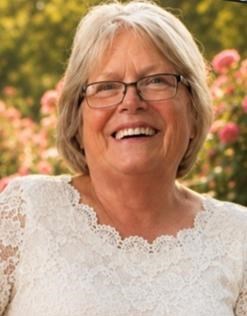
Arlyce Jean Frost
January 26, 1954 – August 16, 2026
Arlyce always said that crying was good.
She said it often enough that her family can still hear her saying it. Feelings were meant to be let out, not held in and tears were nothing to apologize for.
So let me begin there, on her authority: if you need to cry this morning, cry. She'd want it. She'd probably hand you the tissue.
She came into the world in Seattle on the twenty-sixth of January, 1954, a daughter to John and Marjorie Kummer, and a sister to Gary and John. She grew up in Alderwood, in Mountlake Terrace, in Brier, in that stretch of Snohomish County that was still half-country back then.
She had a best friend named Donna, and the two of them were close enough that Donna eventually married Phil's brother, which is how some friendships in this part of the world get made permanent.
And she roller skated. This is one of the first things her family tells you about her, and it's worth pausing on; a girl on wheels, going fast, going in circles, going beautifully.
She loved figure skating enough that years later she made sure her own daughter had lessons. Some joys you don't just keep. You hand them down.
She met Phil, and they married their senior year of high school. Fifty-six years of marriage. Fifty-six years.
They went straight to Arizona, where Phil was stationed with the Air Force. And where Carla spent her first year of life. Then Alaska, where their son John was born in Fairbanks, and where Arlyce, for a spell, worked as a telephone operator on the pipeline.
Picture that, if you can: the young mother from Brier, in the Alaskan cold, on the line.
Then home to Washington. And then, for forty-eight years, one house in Lake Stevens.
Forty-eight years in one house. That is not an accident. That is a decision, made every single day, about what a home is for.
Arlyce was a homebody, and she built the kind of home a person would want to be a homebody in — the kind where the grandchildren know which cupboard the cups are in, where the good memories stack up in the corners like light.
She was also, let it be said, a perfectionist. Meticulous.
Her closets were organized to a standard that Phil found frankly unreasonable, maybe even slightly exasperating. But fifty-six years is long enough for that to stop being a complaint and start being a love letter.
If you had asked her what she was, she would have told you: a mother.
Carla says it plainly — motherhood was a calling for Arlyce. Not a role she fell into, not what happened while she was doing other things. A calling.
She gave up a great deal for it, and she would tell you it wasn't a sacrifice at all; it was the thing itself.
She made sure Carla graduated, made sure she was in the honors classes, made sure she was pushed and held at the same time. Phil was the provider. Art was the mother, front and center, and family was front and center with her.
And Carla, being who her mother made her, became something of a second mother to her younger brother John.
Two children. Fourteen grandchildren. Sixteen great-grandchildren.
Read those numbers again slowly. That is a woman's life, arithmetic that keeps going after she's gone.
Nothing made her prouder. Not one thing. Family was everything to her. Family was just front and center of everything she was. She was above all, a person of family.
And speaking of arithmetic — she was whip-smart at mathematics.
After the children were older, she went to work at Everett General in admitting, and then she went back to school at Everett Community College, where she graduated with academic honors. And then she kept going, toward a bachelor's degree at the University of Washington. Mathematics again.
Here is the part her family wants you to know: she didn't do it because a job demanded it. She did it because it was hard and she wanted to see if she could. She liked the challenge. There was a mind in there that liked a locked door and a puzzle, and she went at it for the pure pleasure of the work.
So hold two pictures at once. The immaculate closets, the beans made a certain way, the eggs made a very certain way — and a woman working proofs at a kitchen table because the difficulty of it delighted her.
Now. The spaghetti sandwich.
Because we cannot honestly gather here and pretend Arlyce Frost was a solemn woman.
She loved Coca-Cola. Hamburgers. Pizza. She would put spaghetti on a sandwich and then smother the whole plate in ketchup. She didn't much care for cooking, but her baked beans were good and her barbecue pork was better. She loved berries of every kind — strawberries, raspberries, marionberries.
She loved roses.
She loved music the way people love it when it's carrying their whole youth inside it: Kool & the Gang, the Beatles, the Bee Gees, the Beach Boys, Elvis. Stacks of CDs. And then, right alongside all of it, hymns — which she would put on and listen to, and which were not a different category of music to her at all.
And she loved birds. She kept parakeets. One of them learned that when the purse came out she was leaving, and would hop onto the purse to stop her. When the family went to Ocean Shores, where birds were not permitted, the parakeets went too — smuggled in under blankets, which is either a small crime or a great love, depending on your view.
One of them was named JJ. JJ liked spaghetti. And one evening JJ committed fully to that preference and flew down into the middle of Grandma's plate, and had to be rinsed; feather by feather… out of the tomato sauce.
There was also a wild rabbit. It adopted her. It kept coming back to her garden, and she named it “Precious”. Of course she did. Even the wild things could tell.
She loved the water.
Every year of camping trips revolved around fishing, because fishing is what Phil loved, and love goes where the other one is going. They bought a Bayliner. They went out into the San Juans; Orcas specifically, Cypress, all of it — because Art simply loved nature, loved being on the water, loved swimming in it.
Her place was Mount Constitution on Orcas Island. Her lookout perch. She would sit up there and watch the sun go down over all that water, and she would take pictures — she loved photographing what she saw.
There was skiing, too, at Whistler and Blackcomb. There was Hawaii, again and again, where she learned the hula and danced it. Europe. Canada. And there was her own mother, whom she was exceedingly close to, and the two of them playing Scrabble for hours on end.
She wanted very badly to get to Panama, to see Carla and those grandchildren on their own ground. She didn't make it. I won't pretend that isn't a sorrow. But I'd ask you to notice that everything she would have found there; the myriad children of her daughter's house, the faith, the grace, the fierce ordinary devotion — she had already sent ahead of her. It was already there. She built it and shipped it decades ago.
I want to say one more thing, and it's possibly the most important one.
Arlyce was raised on hellfire and brimstone. She was handed a God who was mostly thunder.
And she spent her life listening for the quieter voice underneath it.
She concentrated on grace. She called on Jesus through every trial — not as a threat she was fleeing, but as a friend she was leaning on.
Carla says that watching her mother grow in grace over the years was one of the amazing things of her life. That's the inheritance: not the fear she was given, but the mercy she chose instead and handed on. She took what she was given, and she made it kinder before she passed it down.
When the final hour came, she was ready. She said so. She did not want the hospital. She wanted to go to the ocean, and they took her there at the end — to the water she had loved since she was a girl on skates in Brier. And she was still, after fifty-six years, in love with her husband.
Her favorite color was blue.
The color of the water she loved. The color of the long view from Mount Constitution. The color of the sky in that last hour after the sun has gone down, when the light is still there but the source of it has slipped below the line.
She has slipped below the line. The light is still here — in Phil, in Carla, in John, in fourteen grandchildren and sixteen great-grandchildren, in every one of you carrying some piece of her nurture around inside you.
So go ahead and cry. She said it was good, and she was rarely wrong, and she was certainly not wrong about this.
Rest well, Arlyce. The water's calm.
Well done Art, thou good and faithful servant.
A Celebration of Life will be held at Evergreen Funeral Home, 4504 Broadway, Everett, WA 98203, US, on September 11, 2026, from 10:00 am followed by Graveside Inurnment from 11:00 am to and a Reception from 11:30 am to 2:00 pm.
Show your support
Send Flowers
Add a Memory
Share Obituary
Get Reminders
Past Services
Celebration of Life
Graveside Inurnment
Reception
- SEND FLOWERSSEND
FLOWERS SHARE OBITUARYSHARE
- GET REMINDERS
v.1.18.0