
OBITUARY
William Warren Jeswine
August 1, 1942 – August 18, 2026
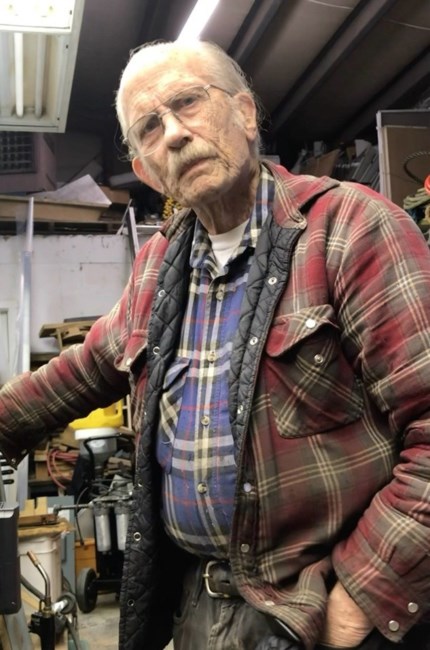
William "Bill" Warren Jeswine passed on August 18, 2026, at the age of 84. He was born August 1, 1942 to Frederick Jeswine and Edna Madeline Baldwin in Helena, Montana. William was a resident of Everett, Washington. William was an lifelong inventor and held many patents. He was preceded in death by his 5 children and his wife.
________________________________________________________
Tribute by John White
I first met Bill 25 years ago, when he was demonstrating a device that would cut aircraft external maintenance time and cost by 95%. The strong objections of maintenance unions prevented this device from being widely adopted.
Bill was a prolific inventor, in a wide variety of arenas, cheerfully ignoring established principles and creating solutions that simply worked. A true Iconoclast. He never saw a box that he couldn’t think outside of!
In his early years Bill worked as a diver in Lake Washington, removing logs. Not satisfied with that level of challenge, he took up skydiving, making many jumps, including one in the original Kingdome. In his most dramatic jump, his parachute did not open and he plunged at high speed toward the ground, removing limbs from the tree he was passing, which allowed him to Hobble away… He often subsequently wondered why he had been spared at that point. His other significant parachute story was packing the parachute used by DB Cooper in his skyjacking.
Bill’s long-time companion and wife, Alice, supported his ambitions to change the world, after they both ran a Chinese restaurant on Vashon Island. They subsequently lived and worked in south Seattle, on Boeing field and South Park, where they were able to watch over the workshop at night, while working all hours during the day, and rescuing feral cats.
Bill’s family were also inventors, with Cyrus Hall McCormick, on his mother’s side, inventing the first commercially successful thresher. More recently, Bill’s father was responsible for developing the “gain” capability which ultimately allowed for the functioning of sonar at sea during WW2. One of Bill’s most significant and recognized developments was the mechanism that today allows pilots to eject safely from their aircraft. This accomplishment resulted in a Boeing chairman’s award.
While commercial setbacks plagued Bill’s career, he leaves a rich trove of unique thinking in the form of intellectual property and patents for the benefit of humanity.
_______________________________________________________
Tribute by Gordon Chanen
William "Bill" Jeswine
Bill Jeswine, a Seattle-area inventor and engineer whose work reached NASA, Boeing, the U.S. Air Force, and NOAA for more than 40 years, died in August at age 83 in Everett, WA.
Bill's father (also an important inventor who figured out how to make Sonar work for the Navy in WWII) inspired in him both the drive to invent and to always seek to 'listen for and uncover how an invention's needs could create paths to genuinely innovative solutions'. He went directly from high school into the U.S. Air Force, where he'd hoped to work on missile systems; instead, his aptitude test results led the Air Force to assign him a job few others wanted — nuclear weapons mechanic.
When Bill left the military and returned to the Seattle area, those specialized skills had little civilian use. He worked his way through a series of ventures — running a print shop, salvaging sunken logs, and eventually, with his late wife, Alice, operating a parachute center in the valley near Issaquah, on land now home to Costco's corporate headquarters.
It was at the parachute center that his inventive streak found a public stage. Bill staged exhibitions in which he walked out onto a plane's wing before jumping — stunts that drew newspaper coverage and, in time, brought the attention of NASA and Boeing to the novel innovations he was developing in parachutes and paragliders. Resulting assignments from both organizations led him to found Skywalker Industrial, Inc., named for his wing-walking shows. He parachuted more than 1,500 times, including once when both his main and reserve parachutes failed; he survived by falling through a stand of pine trees that slowed his descent enough to walk away.
Through Skywalker Industrial, Bill led projects solving difficult technical problems for government agencies and major aerospace companies: the landing mechanism for the Mars Sojourner rover for Boeing Aerospace, a space shuttle engine nozzle for NASA, a wind-blast protection system for the Air Force's F-22 ejection seat, an aerial deployment system for deep-ocean buoys for NOAA, and fire suppression and rescue technologies used by public safety agencies. When Boeing faced repeated failures assembling carbon-fiber wings, Bill invented a way to precisely measure the tackiness of the adhesives used in composite layup — a breakthrough credited with helping make possible the largely composite construction of Boeing's 787 and, later, Airbus aircraft, and still used industry-wide today. His ejection-seat work earned Skywalker Industrial the Boeing Corporation's Chairman's Award, and his broader work for Boeing earned the Boeing Military Airplane Company's Efficiency Award. He was personally named on nine patents over his career.
Show your support
Send Flowers
Add a Memory
Share Obituary
Get Reminders
Services
- SEND FLOWERSSEND
FLOWERS SHARE OBITUARYSHARE
- GET REMINDERS
v.1.18.0