
OBITUARY
Evis Beaton
October 26, 1931 – March 2, 2024
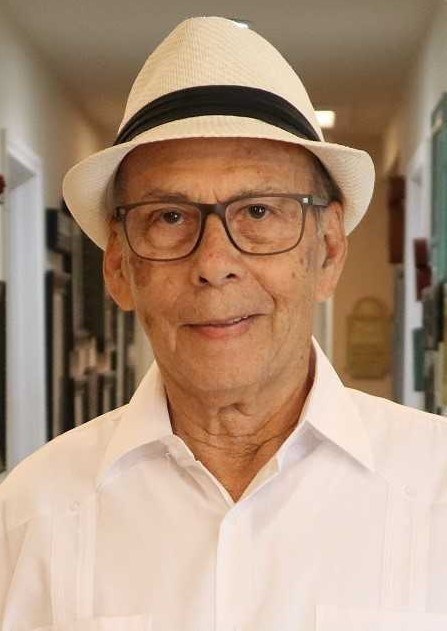
Evis Beaton, age 92, of Temecula, California passed away peacefully on Saturday, March 2, 2024, and entered eternity to join his loved ones that preceded him, and is in the presence of The Creator forevermore. Evis is survived by his wife, three sons and daughter, ten grandchildren, a great-grandson, three sisters, his daughter-in-law, his son-in-law, cousins, nieces, nephews, and many friends.
Evis was a man of faith and his daily devotions and petitions included this self written prayer: "A Ti Senor me encomiendo y te pido que vuestro infinito poder divino nos libre, a mí y a los seres queridos de mi familia de todo mal a nuestra salud y a nuestras vidas."
Thanks to all you who have given your friendship and love to Evis and to the Beaton family throughout his lifetime, and the many encouraging visits, thoughtful words of support and prayers.
Evis loved people, he was always eager to host company, friends and family alike. He would often ask if you wanted Cuban coffee which he was an expert at making, and no one that has ever tried his "tostones" will ever forget how good they were, its a family secret that we will continue to enjoy for many generations.
Be of good cheer and be encouraged, you who gave him love, know that he loved you back and appreciated you very much and we are grateful to have you as family and friends. Evis will be forever in our hearts.
In Loving Memory of
Evis Beaton
October 26, 1931 - March 2, 2024
Early Life
Evis was born on October 26, 1931, at his family ranch in an area called "Ceiba de Beaton" located in the Sierra Maestra mountains near Ramón de Guaninao, in the city of Palma Soriano, in the province of Santiago de Cuba, Cuba.
His father Alcibiades Beaton was the son of Emiliano Beaton who was a Lt. Colonel in the Cuban Liberation Army infantry division that fought against the Spanish Crown in the wars for independence which started in 1868 and culminated in the final war of 1898, the Spanish-American War.
During the fight for Cuba's liberation from Spanish rule, many members of the Beaton family fought bravely. Among them were Emiliano Beaton and his brother Buenaventura Beaton, who are now remembered in Cuban history as heroic patriots of the newly independent nation. The peace treaty which marked the end of the war was signed under a large ceiba tree in Santiago de Cuba. A memorial was later erected under this tree at the Parque Historico San Juan. The memorial features large bronze open books, replicas of the peace treaty, which include the name of Col. Buenavista Beaton listed on one of the plaques.
Evis's mother was Aurora Roca who married Alcibiades when she was about 16 years old and gave birth to seven children; three boys and four girls. The Roca-Roldan family was also from the same area of Palma Soriano and were friends of the Beaton family.
Evis was given his name by his father Alcibiades who named him after a good friend he met in Alabama while attending a university course in agriculture when he was a young man. Alcibiades never forgot that good friend who was of Italian descent and named his second-born son, Evis.
Evis grew up on his family ranch, which was part of a large agricultural valley called "Cieba de Beaton" a multi-generational land holding owned by several branches of the Beaton family. The area spanned more than one thousand acres of rolling hills and valleys rich with ceiba trees, oaks, mango, papaya, coconut trees, and coffee plantations which was his family's major production crop. They also kept cattle, goats, and chickens and harvested just about all that they ate from the land they loved and developed.
Evis enjoyed exploring the "Cieba" valley on horseback, often riding bareback as was customary in those days. He used to tell us that one could venture out in the morning to ride around the valley and not return until sundown.
Evis received his early education in a small town where his aunt was a teacher. The teaching style was similar to that of Little House on the Prairie, where children of different ages learned together in a single class, but each with their own textbooks tailored to their level.
His family owned a home in the downtown area of Santiago de Cuba, which was situated just a few blocks from the port. The town was vibrant and lively with several shops, restaurants, and parks located nearby. He would often shuttle between the ranch and the city, relishing and valuing both lifestyles.
In his teenage years, he attended an advanced college prep high school called "Instituto preuniversitario vocacional". The school allowed students to graduate with majors in their preferred fields of study. His chosen majors were mathematics and arts.
Work and Family Life
Throughout his lifetime in Cuba, Evis was always involved with his family ranch and helped with the production, harvest, and sales aspects of the coffee business, especially so after his father Alcibiades passed away when Evis was only 25 years old and his mother Aurora was left a young widow.
He began working as a teenager at an import/export agency owned by a family friend. It is here that he gained experience and knowledge that ultimately led to his first major job at the Port of Santiago De Cuba, in the customs department some years later.
Evis was highly skilled in the import/export industry and earned the admiration of his colleagues and superiors at the Port of Santiago. He was continuously promoted until he became the customs manager at the second largest port in Cuba. It was there that he met Rosalia Castro, a young woman who worked in office administration in the same building.
Evis first met Rosalia while working at the Port of Santiago de Cuba. He always recounted how he was immediately struck by her presence, saying that she was beautiful and he loved the way she carried herself. Evis thought that Rosalia was very proper and he even told his colleagues at work "I am going to marry that young woman".
They laughed at him and said, "You don't even know her, and she may just be too young and beautiful for you" being that Evis was about 7 years older than Rosalia. But that didn't deter Evis at all, he was then and always remained a very charming and handsome man, he knew how to converse with people and his personality was pleasant and confident and he always left one feeling good about having spent time with him.
He asked Rosalia if he could visit her at her home and meet her parents which was the custom of the time, and she said yes.
After being questioned by Rosalia's mother, Maria Constanten, about his intentions, Evis was allowed to talk to Rosalia at her home under the supervision of their parents and siblings. Rosalia's father, Pedro Castro, was the son of Miguel Castro, a Spanish soldier who fought for the Spanish Crown in the War of Independence in Cuba in 1896. Pedro became like a father to Evis, and they developed a deep love and respect for each other. This marked the beginning of Evis and Rosalia's love story, which lasted for over 62 years until Evis's recent passing.
Evis and Rosalia had four children. Their firstborn was Carlos, followed by Evis and Richard. Finally, they had a little girl named Susan.
Due to his unique name, Rosalia was hesitant to name her firstborn after his father, so Evis agreed to name him Carlos. Evis mentioned that if they had a second boy, he would name him after himself. Thus, the second son was given the name Evis.
The communist revolution in Cuba brought chaos to the lives of the young family and many others. In the early 1960s, Evis and Rosalia requested permission to emigrate to the United States as political refugees. However, it took them about five years for their request to be granted. As they both sought to leave the country, they were soon labelled as traitors and subsequently dismissed from their government jobs at the Port of Santiago.
During these difficult years, they worked odd jobs, sold and bartered their baked goods and desserts. Evis even made some extra money by taxiing people around. It was during this time that little Evis was born.
On February 2, 1966, Evis, Rosalia, and their two sons departed Cuba in search of freedom. They were accompanied by Rosalia's brother Pedro Castro, his wife Gladys, and their daughters Maria, Giselle, and Gladys. These two families were united in their struggle to survive and provide for their children. They hoped to make a better life for themselves in a country that valued freedom and rewarded hard work with success and abundance - the American Dream.
Rosalia had family in Puerto Rico that had moved to the island before the 1959 communist revolution in Cuba and that was their first stop on their journey to the USA. In the year they lived in Puerto Rico, Evis worked part-time at a supermarket and also as a bar manager.
During that short stay in Puerto Rico, son Richard was born, but the families had decided to migrate to New Jersey where opportunities for manufacturing jobs brought hope for higher wages and more steady income, a chance to move ahead.
Evis and Uncle Pete left Puerto Rico first to secure work and housing for the families and within 3 months they had secured both. The wives and kids were then reunited with the men in Elizabeth, New Jersey.
In New Jersey, Evis worked a full-time job and sometimes had part-time weekend jobs just to make enough to support his family.
He and Rosalia both worked for Western Electric, Evis worked as a punch press operator, then a silk screener and He also sold vacuum cleaners on the weekend for extra income.
Braving the extremely cold winters so foreign to them as islanders, the families acclimated as best they could, initially taking public transportation to work and eventually buying their first cars and soon after becoming homeowners.
All this was a monumental achievement within 5 years of arriving in the U.S. without money, without knowing the language, and without any financial backing, the American Dream was realized.
In 1973, Evis and his wife welcomed their daughter Susan in New Jersey. She was their first daughter after having three sons. During this time, Evis attended night school in New Jersey and earned his GED. Additionally, he studied English and took correspondence courses in electricity.
Throughout his life, Evis felt a responsibility to not only provide for his immediate family but also to his mother and siblings who remained in Cuba. They struggled in the weak economy under the communist regime, where no matter how hard one worked, they could barely afford enough to eat. Theirs was a difficult existence, which continues even today. Evis regularly sent Western Union payments to his mother to help his family, and they always appreciated his generosity.
In 1976, after experiencing a company-wide layoff at Western Electric, Evis and Rosalia made the decision to relocate to California. They hoped that moving to a warmer climate would provide a better environment for their children and help them achieve their American dream. To make this happen, they sold their home in Elizabeth, N.J. and packed their bags for Southern California.
Evis had an Uncle named Aramis Roca who was the brother of his mother Aurora. They had lived in California, not far from Azusa, where Evis and his family had first arrived. Aramis was only a little over a year older than Evis, so they grew up together in Cuba and were more like brothers than uncle and nephew. The friendship between the Rocas and Evis's family was highly valued and cherished by everyone, both during those years and afterwards.
Upon arriving in California, Evis and Rosalia decided to become business owners and purchased a fast food stand called Ozzie's Burgers on Azusa Avenue in Azusa. They also rented a home in the same area. Despite their hard work to make a profit, the food establishment barely made enough to meet the growing needs of their families.
After a few years, Evis & Rosalia decided to sell their business and find new jobs, which they quickly did. They started earning and saving steadily, with the goal of buying a house in Covina. Eventually, they were able to purchase a house where they lived with their family until all the kids were grown and had moved out on their own.
After selling Ozzies Burgers, Evis worked in the production department for Miller Brewing Company and Anheuser-Busch, where he cleaned and maintained brewing tanks and equipment.
Evis later joined ITT Barton Instruments where he began his career as a drill press operator. He was ambitious and aspired to progress in the large manufacturing machine shop, which produced valves and gauges for the oil industry. Evis had a kind-hearted nature and always managed to make good friends along his life's journey. Due to his loyal and devoted nature, his friends provided him with valuable advice and opportunities to succeed.
There was a manager named Max at ITT who recognized and appreciated Evis's exceptional work ethic. Despite many of his colleagues having been there for longer periods of time, Evis managed to produce twice as many parts as others, with an almost non-existent part rejection rate. This was due to his excellent mathematical skills, attention to detail, and strong work ethic, which made him a great machinist.
At the encouragement of his manager Max, he decided to enroll in a certification course in CNC machining at Citrus College. Max suggested that obtaining this certificate would give him a competitive edge over his peers, leading to higher earnings and greater job security. Despite being over 50 years old, he took the leap and pursued this opportunity at Citrus College.
Evis successfully completed the course with high grades, and his hard work paid off when he was promoted to a CNC machinist position. He continued to excel at his job, advancing in his career until he decided to retire at the age of 72, after many years of dedicated service.
Golden Years, Travel, and Hobbies
Evis and Rosalia traveled to Oahu Hawaii, Alaska, Niagara Falls, Cabo San Lucas, Puerto Rico, Cuba, and Europe where they visited Spain, France, Italy, Monaco, and Venice.
Evis became a grandfather at the young age of 57. In a short time, he had a total of ten grandchildren, including one great-grandson who fondly referred to him as "old grandpa" to differentiate him from Evis Jr., whom he called "young grandpa".
Evis and Rosalia were always very involved in the lives of their grandchildren. They attended school events, including Grandparents' Day, sports games, and graduations. There were many birthdays and holidays throughout the year, which were celebrated with delicious Cuban food, lots of conversation, as well as dancing and singing at our gatherings.
Evis had a sweet tooth and indulged in dessert every day without any negative consequences due to his great genetics and active lifestyle.
Evis has had a passion for agriculture ever since he was a child. He has kept that love alive by planting and tending to many fruit trees that produce abundant fruit, such as oranges, lemons, pomegranates, guava, persimmon, figs, avocado, peaches, and banana trees. Evis always tends to his own gardening, mows the lawn, and trims trees. He definitely has a green thumb.
For decades, he loved playing the California Lottery and used his mathematical skills to identify probabilities in the lotto number draws based on past number draws. He always told the family that if he ever won big, he would share the winnings with them. Although he never bet very much, it was always for fun more than anything. But honestly, we hit the lottery already just having him in our lives.
Evis also loved music and dancing. He and Rosalia often performed at family events showing off their skills and bringing smiles to the faces of family and friends. He also enjoyed storytelling and jokes when friends and family gathered together.
He had a passion for cooking and would often prepare his delicious Cuban-style black beans whenever we had family gatherings, without ever boasting about it. The recipe for his special garlic-marinated fried tostones has been treasured by our family for generations. He was also an expert in making Cuban espresso coffee, which he brewed in an old-fashioned stove-top percolator. We may be biased, but we believe it was the best coffee ever!
Evis delved into numerous books on vitamins, minerals, nutrients, and superfoods, exploring how they could promote youth and health in the human body. He had a specific breakfast that he ate nearly every day and took supplements regularly. His great-grandmother, Manuela Beaton, lived to be 114 years old, and he always hoped for similar longevity, which he was indeed blessed with.
Evis had a great voice that harmonized well with Rosalia's. They often sang together at family events and always called their kids and grandkids on their birthdays for a "Happy Birthday" phone serenade.
Since childhood, he loved animals and raised chickens, doves, and sheep. Over the years, his family had many cats, dogs, hamsters, turtles, chickens, and parrots.
Evis used to walk nearly 2 miles every day until he turned 90. He enjoyed wearing his "90 Never Looked So Good" cap and would playfully tease strangers who looked older than him, telling them that they were young enough to be his child!
He always greeted his family and friends with a hug, kiss, and a kind word. He even hugged and kissed his sons, teaching them to be affectionate. This example will continue into future generations.
Evis Beaton was a remarkable man who paved the path of freedom for his and future generations. He was known for his strong will, and determination, and considered to be a hard-working and reliable individual. Evis had a passion for music, God, nature, and life itself. He was a loving father, grandfather, and great-grandfather, deeply devoted to his wife Rosalia. Although he is no longer with us, he will always remain in our hearts and memories.
Show your support
Add a Memory
Share Obituary
Get Reminders
Services
SHARE OBITUARYSHARE
- GET REMINDERS
v.1.18.0