
OBITUARY
The Rev. Charles G. Newbery
April 17, 1928 – August 25, 2025
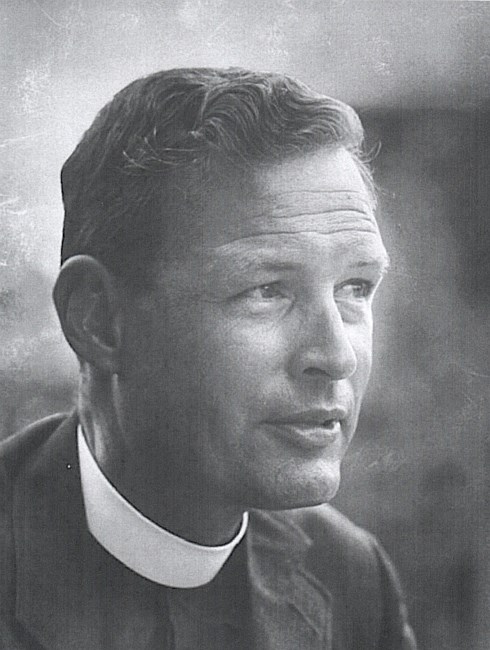
The Rev. Charles G. Newbery, who was active in the affairs of the Episcopal Church and the General Theological Seminary in New York City while also serving as the Rector of several Episcopal churches, died on August 25, 2025, in Houston, Texas. He was 97.
He began his ministry in Poughkeepsie, New York, and beginning in 1955 he served at Trinity Church and All Saints’ Church, both in Princeton, New Jersey. While in Princeton he led a busload of parishioners to attend the March on Washington in August 1963. From 1965 to 1969 he was the Rector at Christ Church in New Brunswick, New Jersey. After the Rev. Martin Luther King was assassinated in April 1968, he wrote a tribute to Dr. King urging a diocesan convention to pledge itself “to struggle against racial injustice, to support poverty legislation, [and] to welcome Black leaders in decision-making.” In October 1968 he was one of five Protestant clergy featured in a Life magazine article about the challenges of trying to involve their congregations in the civil rights struggle. Speaking of his own efforts, he described devising ways to “help show the parish that there is an opportunity for a Christian to be a Christian where the action is.”
From 1969 to 1974 Father Newbery was the Rector at St. John’s Episcopal Church in Roanoke, Virginia, before becoming the Rector at St. John’s of Lattingtown in Locust Valley, New York, serving there and on the Economic Justice Implementation Committee of the Diocese of Long Island until retiring in 1993. Every July from 1963 to 1998, he also presided over services at St. James Episcopal Church at Prouts Neck, a summer community in Scarborough, Maine.
He served in the House of Deputies at triennial sessions of the General Convention, the Episcopal Church’s bicameral legislature, and supported the revisions to the Book of Common Prayer adopted in 1967 and 1970. In 1975, he chaired a 10-member Board of Inquiry appointed by a committee of bishops to investigate charges against four bishops accused of violating the Church’s constitution and canons by participating in the ordination of 11 women deacons to the priesthood in July 1974. The Board had to determine whether the accused bishops should stand trial. In the Board’s majority report, issued after an 8-2 vote, he and seven others concluded that because the core of the controversy was doctrinal, as a matter of canonical law the Board was without jurisdiction, and the House of Bishops was the proper forum for addressing the charges. In 1976, the General Convention authorized the ordination of women, making the 1974 ordinations a breakthrough moment rather than a canonical offense.
Father Newbery also chaired the Standing Committee of the Board of Trustees of General Theological Seminary. In 1978, he oversaw the sale of the seminary’s copy of the Gutenberg Bible, one of 48 known to exist, for $2 million in order to raise money to endow the seminary’s library. He told The New York Times, “I’m delighted that it achieved the price that it did but am personally sorry that we had to decide to part with the Bible.” The seminary later awarded him an honorary Doctor of Divinity degree.
Father Newbery was born in 1928 in Chicago, where his father, Alfred Newbery, was the Rector of the Episcopal Church of the Atonement and later served as Rector at the Church of the Advent in Boston. The family eventually settled in Ridgewood, New Jersey, where Father Newbery grew up. He attended prep school at the Kent School, spending a year of post-graduate study at Clifton College in Bristol, England, before attending Yale University, from which he graduated in 1951 with a degree in history. He graduated from the General Theological Seminary in 1954, marrying Jane Bollwinkel of Port Washington, N.Y. in the same year. He is survived by Jane; their five children: John, of Brooklyn, N.Y.; Peter, of Houston, TX; Sheila, of Berkeley, Calif.; Patrick, of Berkeley, Calif.; and Sarah, of Houston, TX; seven grandchildren: Andrew, Emma, Caroline, Sam, Ben, Mika, and Marsden; and two great-grandchildren: Sophia and Joshua.
While living in Locust Valley, he and Jane enjoyed playing golf on the many beautiful public courses there. After his retirement, they lived in southern Maine, where they volunteered for Pinetree Legal Assistance and took up square and round dancing, and in Berkeley, California before coming to Houston in the summer of 2021. He also enjoyed sailing, which he taught himself in his teens, jigsaw puzzles, word puzzles, puns, and trying to convince his family that he could give accurate weather predictions.
Show your support
Add a Memory
Share Obituary
Get Reminders
Services
SHARE OBITUARYSHARE
- GET REMINDERS
v.1.18.0