
OBITUARY
James Bell Jim"" Benedict
November 11, 1938 – March 8, 2011
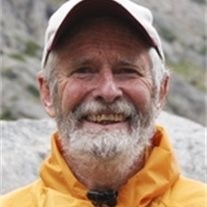
James Bell Benedict, 72, acclaimed Colorado geologist and archaeologist, died peacefully Tuesday, March 8, 2011, at his mountain home west of Jamestown in the guardian shadow of Sawtooth Peak. Jim was surrounded by and in the loving embrace of his family after a long, brave struggle with Alzheimer’s and a short, fierce battle with kidney cancer.
Jim was born in Cincinnati, Ohio on November 11, 1938 to the late James Bell Benedict, Sr. and Katharine Taft Benedict. His survivors include Audrey DeLella Benedict, his loving wife and partner of 41 years, his former wife Diane Goode Benedict of Lyons, son Robert J. and wife,Margie Villegas Benedict, and grandchildren Noah and Zoe of Boulder, and son Dr. William L. and wife,Mary Hartman Benedict, and grandchildren Steven, Lauren, and Jayne of Longmont, and his beloved black Lab, Scruggs.
Fascinated by geology and the West since childhood, Jim briefly entertained the romantic notion of becoming a mineral prospector after graduating from Phillips Andover Academy. Though he would remain an ardent pacifist all his life, Jim felt the need to give back to his country and was proud of his service in the U.S. Marine Corps. With that service behind him, his abiding love for pristine high mountain landscapes took him to the University of Colorado. While at CU, Jim was inspired by his favorite professor and mentor, Dr. William Bradley, to study geomorphology and glacial geology. Jim received his B.A. in Geology from the University of Colorado in Boulder in 1961 and his Ph.D. in Geology from the University of Wisconsin, Madison in 1968. For his outstanding scholarship, he was made a member of the Society of the Sigma XI, Phi Beta Kappa, and received CU’s W. A. Tarr Award. As aresearch scientist with CU’s Institute of Arctic and Alpine Research from 1961 to 1970, Jim conducted periglacial studies in the tundra of Niwot Ridge. That work won him the prestigious Kirk Bryan Award from the Geological Society of America.
Leaving the traditional confines of academia to form the Center for Mountain Archaeology in 1971, Jim devoted his remarkable genius for multidisciplinary research toward investigating the record of Holocene climatic change in Colorado’s high mountains and the ways in which prehistoric peoples adapted to these changes. Though his field research focused primarily on the Colorado Front Range, Jim spent considerable field time in the Mt. Everest region and in the Alaskan and Canadian Arctic. His research was often groundbreaking, running the gamut of studies of Front Range glaciers, alpine plant ecology, mountain archaeology and prehistoric game-drive hunting systems, timberline dynamics, lichenometry, and ethnobotany. The scope of Jim’s expertise and the scientific integrity that he brought to everything he did went well beyond geology and many of his colleagues refer to him as one of the “giants of Colorado archeology.” Jim was a generous friend and mentor to his students over the years, his legacy carried forward in their research and in their interactions with their own students. Dr. Steve Cassells, Jim’s longtime friend and colleague, recently wrote of Jim: “For nearly 50 years he scrambled over most of the terrain from Rollins Pass and James Peak on the south to Rocky Mountain National Park on the north. During those years he managed to publish more than seventy professional papers and books (including the widely praised Center for Mountain Archeology Research Reports, of which there are eight). His exacting methodologies and creative research approaches have inspired generations of archaeologists and geologists.”
The loss of Jim Benedict is felt deeply by his family and the many friends who loved him. He was an extraordinary husband, father, grandfather, and friend—just a boy himself in the way he embraced life and everyone around him. The true home of his heart was always in the Colorado mountains, especially the alpine tundra of the nearby Indian Peaks Wilderness. Sharing these places with those he loved gave Jim special joy. He enjoyed hiking and cross-country skiing, exploring mountain landscapes wherever he went—the Alaskan and Canadian Arctic, Southeast Alaska, Argentina, and the Subantarctic island of South Georgia. Discovering the magic of the Pacific Northwest from a sea kayak opened yet another window on the natural world. Jim was fascinated by the natural world; his dedication to conservation stewardship remains a lasting legacy and lives on in each of us.
Private memorial services are planned for March 27, 2011. Cremation has been entrusted to Howe Mortuary. Contributions in Jim’s memory may be directed to Hospice Care of Boulder and Broomfield Counties (www.hospicecareonline.org) or to the James and Audrey Benedict Mountain Archaeology Fund at Colorado State University (www.foundation.colostate.edu).
Show your support
Add a Memory
Share Obituary
Get Reminders
Services
SHARE OBITUARYSHARE
- GET REMINDERS
v.1.18.0