
OBITUARY
William F Savidge
March 5, 1923 – August 6, 2015
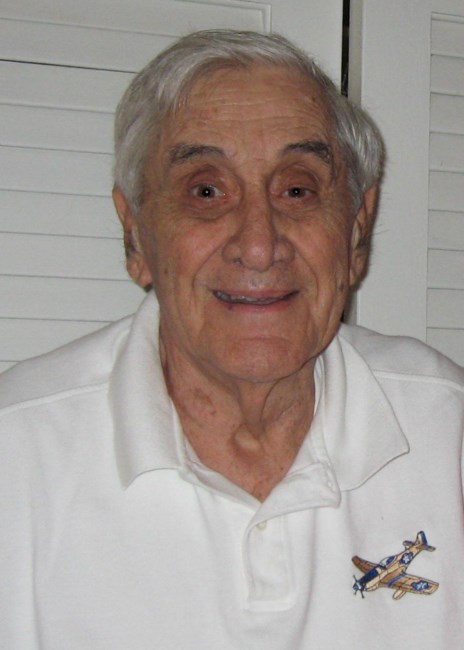
March 5, 1923 - August 6, 2015
William "Bill" Savidge, Jr., born on March 5, 1923 in Pottsville, Pennsylvania, to Rev. William Franklin Savidge and Esther Miles Savidge, died at AVOW Hospice, Naples, Florida, on August 6, 2015. Olivia, his wife of 71 years, was at his side.
As a 12 year old, Bill yearned to become a pilot when he saw an autogyro in a Harrisburg field. "I was fearless," he said, often jumping onto large chucks of ice that had broken loose on the Susquehanna River. His hero was Doc Savage, the Lester Dent hero. As a youngster, he spent many summers working at his aunt's Norristown farm.
When the government began recruiting for the military, he saw the film "Winning Your Wings" and decided that was for him. After graduating from Hazelton High School, he worked at the Middletown Air Depot as a learner-helper to plane mechanics, and three months after Pearl Harbor volunteered for the Army Air Corps. A co-worker urged him to write down Psalm 91:7, that he would need it.
His preflight training was at Maxwell Field, Alabama, and primary training at Camden, South Carolina, and basic was at Macon, Georgia. His Silver Wings were received at Marianna Field, Florida, and he went on to train in P-47 at Eglin Field, Pensacola. After receiving his First Lt. Commission, he was transferred to Naples, Florida, where he met Olivia Storter and fell in love. His commanding officer at Naples Airfield was Colonel Harrison Thyng, an Ace in two wars, who became a Brigadier General. On one occasion, Thyng reprimanded Bill for doing acrobatic shows over Naples Bay in the Curtis P-40. Training in the P-51 Mustang was at Sarasota, where he got the nickname "Doc Savidge" for setting a new high in scoring for the base basketball team. In February 1945, while awaiting orders at Dale Mabry Army Airfield, Tallahassee, he wrote his bride "Here I am a 21 year old boy from small town Pennsylvania, without a college degree, flying P-51 Mustang for my country, the best, most powerful war-bird in the world, married to the prettiest girl in the world. I am the luckiest man alive."
Bill joined the 531st Fighter Squadron, 21st Fighter Group 20th Air Force as a replacement for P-51 pilots that were killed in a surprise banzai on Iwo Jima on March 26, 1945. Major Harry Crim, of South Florida, was his commanding officer, and Henry Koke of Texas, a self-taught pilot who was later shot down over Japan in trying to rescue a fellow pilot, became Bill's hut mate. Crim and Koke were the only two pilots to complete West Pointer Brigadier General Ernest "Mickey" Moore's inaugural Very Long Range test mission from Iwo Jima to Saipan and back. Moore penned a Second Bronze Oak Leaf Cluster Air Medal on Bill for a June 1st Black Friday mission in which twenty-four pilots were lost. Bill served as an escort to Henry "Hap" Arnold, head of the Air Force, from Iwo Jima to Guam for an investigation of the greatest loss of P-51 fighter planes during any one mission of WWII. On Black Friday, Bill, separated from his wingman in a severe storm with whiteout conditions, flew alone back to Iwo, 150 miles off course. As he prepared to ditch at sea, he felt a calm as though someone was in the cockpit with him. "I remembered the piece of paper in my pocket with the psalm on it, and I told God I was not afraid to die, but I would like to see my wife and new baby girl again." Within minutes, he heard a voice over the radio that instructed him to hum, and the control tower on Iwo Jima was able to direct him to the island. When he landed, his fuel gauge registered empty. After that mission, fellow pilots inducted him into the unofficial Tokyo Club, for pilots who flew VLR missions over Tokyo. He would learn upon returning to the states that on Black Friday, Olivia was praying at a church meeting, and someone came up to her and said to read Psalm 91:7. From that moment, she believed Bill would come home from the war. Bill received the Presidential Unit Citation recognizing units for a collective display of extraordinary heroism, for that June 1st mission. Other honors included Air Offensive – Japan, Air Medal with Two Oak Leaf Clusters, Asiatic Pacific with Two Battle Stars, World War II Victory Medal and American Campaign Medal.
Bill returned to Naples at the end of the war and fished with his father-in-law Robert Storter, a commercial fisherman. W.B. Uihlein, the Milwaukee millionaire, hired him to help establish the Naples Water Department after the war. The best engineers in the country were brought to Naples and Bill learned from the ground up how to run the City's water department. He was named Water Superintendent in 1948, and in 1965 headed the City of Naples Public Works Department, and was Assistant City Manager from 1968 to 1977, with seven months as City Manager in 1976. He retired in 1985. He is said to be responsible for Naples keeping its coconut trees during a lethal yellowing blight by initiating a timely and intense inoculation program. In 1978, he was awarded the American Public Works Association Samuel A. Greeley Local Government Service Award for long and faithful service to the City of Naples since 1947.
In addition to his wife, he leaves behind four daughters and spouses, Billie Ann and Charles Mochow, Burns, Tennessee, Barbara and Jim Cain, Plant City, Florida, Betty and John Briggs, Plant City, Florida, Peggy and Jim Gammell, Naples, Florida. He has 9 granddaughters, one grandson, 22 great grandchildren, and four great great grandchildren. He leaves behind two brothers, John and Thomas, and one sister, Esther Bird.
Visitation will be on Wednesday, August 12, 2015 at Hodges Funeral Home at Naples Memorial Gardens (525 111th Avenue North, Naples, FL 34108) from 6:00pm – 7:00pm. A private graveside service will be held for family later. In lieu of flowers, donations can be made to Avow, 1095 Whippoorwill Lane, Naples, FL 34105 (239-261-4404).
Show your support
Add a Memory
Share Obituary
Get Reminders
Services
SHARE OBITUARYSHARE
- GET REMINDERS
v.1.18.0