
OBITUARY
Henry William Griffin
February 7, 1935 – February 19, 2020
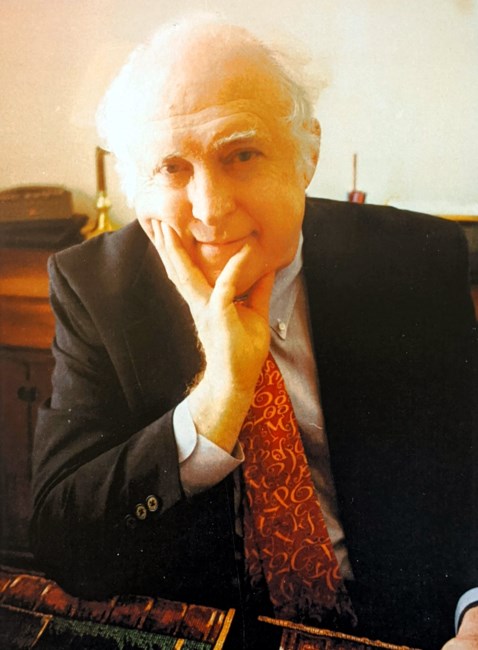
Henry William Griffin, known professionally as William Griffin, passed away on February 19, 2020, at the age of 85. He worked as a writer and editor for 60 years, and was renowned as an authority on the British author C.S. Lewis. He died of natural causes, after a short illness.
William Griffin was born on February 7, 1935, in Waltham, MA, the only child of Henry Francis Griffin, a securities trader, and Margaret Mary Griffin, an Irish immigrant and homemaker. He attended Boston College High School, where he studied Latin and played baseball.
He graduated in 1952 and entered the Jesuit novitiate. He remained in the Society of Jesus for eight years, completing a BA in English Literature. On March 9, 1956, He was survivor of a fire at the Shadowbrook residence that claimed the lives of four Jesuits and injured many more, including Mr. Griffin, who was severely burned. He left the Jesuits in 1959, moved to Washington, D.C., and completed an MA in Drama at Catholic University, after which he moved to New York City to pursue a career in theater.
In 1961, in a playwriting class taught by Edward Albee, he met Emilie Dietrich, also an aspiring writer. He proposed quickly, at Sardi’s, the famous restaurant in New York’s theatrical district. They were married in 1963. They had three children, Lucy, Henry and Sarah. Mr. Griffin’s first play, A Fourth for the Eighth (about Henry VIII’s fourth wife, Anne of Cleves), was optioned by the Broadway producer Burry Fredrik, and his second, Campion (about the life of Jesuit St. Edmund Campion), was given a staged reading at the Eugene O’Neill Center in Waterford, CT. He was also the drama critic for The Sign Magazine, where he published 100 play reviews.
For 20 years, he worked as a book editor, first for Harcourt Brace Jovanovich and later for Macmillian, where he specialized in religious titles. He oversaw the posthumous publications of C.S. Lewis, including the essay collection The Joyful Chistian. This led to a series of theological essay collections, including The Whimsical Christian (Dorothy Sayers), The Newborn Christian (J.B. Phillips) and The Electronic Christian (Fulton J. Sheen). His editorial career culminated in the publication of his first authorial credit: Endtime: the Doomsday Catalog, an illustrated anthology of the apocalypse in literature and history.
He and his family moved to New Orleans in 1980, and he remained a Louisiana resident thereafter. He continued his career as a literary journeyman. He was the religion books editor for Publishers Weekly magazine for much of the 1980’s and 90’s, where he reviewed over 150 books. He also wrote 75 reviews for Catholic Twin Circle. With Mrs. Griffin, he wrote His Holiness Pope John Paul II Visits the City of New Orleans, a commemorative volume. He wrote several novels, from the literary (The Fleetwood Correspondence, an imagined response to C.S. Lewis’s The Screwtape Letters), to the autobiographical (the unpublished Faithful but Unfortunate), to the surreal (Dill of the Nile: The Story of the Wise Man Who Arrived Early). His major literary work, published in 1986, was the exhaustively researched biography Clive Staples Lewis: A Dramatic Life. He authored several books for young people, including Jesus for Children and Bert and Bertha: King & Queen of Kent. In 1997, he edited Just as I Am: The Autobiography of Reverend Billy Graham. He authored or edited many more books on C.S. Lewis, G.K. Chesterton, St. Augstine of Hippo, and Thomas a Kempis.
He maintained membership in many organizations, including the Equestrian Order of the Holy Sepulchre of Jerusalem, The American Literary Translators Association, the Chrysostom Society, an association of collaborative Christian writers that has included Mr. and Mrs. Griffin, Madeleine L’Engle, Luci Shaw, and Eugene Peterson. Mr. Griffin edited or contributed to many of their published anthologies, particularly the serial mystery novel Carnage at Christhaven. He also helped start the Ancient & Honorable Company of Anglo-American Fusiliers, a club dedicated to the British military’s role in the War of 1812. Eventually, Mr. Griffin became an historical reenactor, portraying Sir Alexander Cochrane, commander of the British naval forces at the Battle of New Orleans, for many years at the Chalmette Battlefield. As well, at the 2003 bicentennial reenactment of the signing of the Louisiana Purchase, he portrayed the American General James Wilkinson. He also claimed to be the only member of the “Warm Jam Society,” founded to keep preserves at room temperature.
Mr. and Mrs. Griffin moved to Alexandria, LA, in 1998, where they lived until 2016. Mr. Griffin became active in local theater with Spectral Sisters Productions, of which he eventually became president. He wrote many ten-minute plays for the SSP stage.
Mr. Griffin was orally fluent in Classical Latin and Greek, and worked as a translator till the end of his life. Among others, he translated The Imitation of Christ, by Thomas a Kempis, Sermons to the People, a collection of the work of St. Augustine, and an unpublished retelling of Augustine’s Confessions that he insisted on titling High Anxiety. He believed in Latin as a living language, and once translated Beatrix Potter’s Peter Rabbit into the Roman tongue. For a time he distributed an email newsletter called Verbum Diurnum, a witty and eccentric Latin word-of-the-day.
Mr. Griffin’s literary style was clever and mirthful, with an attention to minute detail. His C.S. Lewis biography (which he had wanted to title Rum Thing, after one of Lewis’s colloquialisms) is as interested in how Lewis puttered through his days as it is in his literary achievements. He loved etymology, and discovering and coining new words. He referred to an imaginary muscle called the “herculator,” which engaged to pick up the heaviest of items ( ie “don’t strain your herculator picking that up….”) and an fictional character named “Mrs. Washmore” who came in to do the daily loads of wash. He called Hershey Kisses “stress-tabs” and staged them around the house in narrow glass jars for daily consumption.
He was a regular follower of the obituary page, which he scoured daily for notable passings. He related them to family and friends with a jolly “Move up one place.” He thought of life as a long line to an inevitable spiritual reward. He lived knowing that everyone eventually has to leave to make room for the new arrivals.
He is survived by Emilie Griffin, his wife of 56 years and author of 18 books; his three children, Lucy Griffin Sikes, and her husband Gerald Herbert, Henry Francis Griffin II, and his wife Larisa Gray, and Sarah Griffin Thibodeaux, and her husband Troy Thibodeaux; and his five grandchildren: Ardis and Avery Sikes, Houston and William Thibodeaux, and Naima Griffin.
William Griffin had a jaunty way with goodbyes. He frequently said “TTFN,” or “Ta Ta for Now.” Later, he enjoyed saying “continuendum est,” Latin for “to be continued.” His final words to his daughter Sarah were “Love you the best,” the emotional mantra of his family.
A memorial mass will be held at Our Lady of Prompt Succor Church, 401 21st Street, Alexandria, Louisiana on Friday March 6, at 1:30 pm, with a reception following at the home of Susan Segura and John Hunsaker, 306 West Dem, Alexandria, Louisiana. A private interment will follow at Grace Episcopal Church in St. Francisville, Louisiana on Saturday March 7. A second memorial mass will be held in New Orleans at St. Rita Church, 7100 Jefferson Highway, Harahan, Louisiana, on Friday March 20, 2020 at 4:00 pm., with a reception following at the home of Gerald Herbert and Lucy Sikes Herbert, 8351 Murlesan Avenue, Harahan, LA.
In lieu of flowers, the family requests that donations to Renovare, a Christian nonprofit that models, resources, and advocates fullness of life with God experienced, by grace, through the spiritual practices of Jesus and of the historical Church at www.renovare.org.
To view and sign the guest book, please visit www.lakelawnmetairie.com
Show your support
Send Flowers
Add a Memory
Share Obituary
Get Reminders
DONATIONS
Past Services
Memorial Mass
Memorial Mass
- SEND FLOWERSSEND
FLOWERS SHARE OBITUARYSHARE
- GET REMINDERS
v.1.18.0