
OBITUARY
Annette Green
April 26, 1924 – October 8, 2026
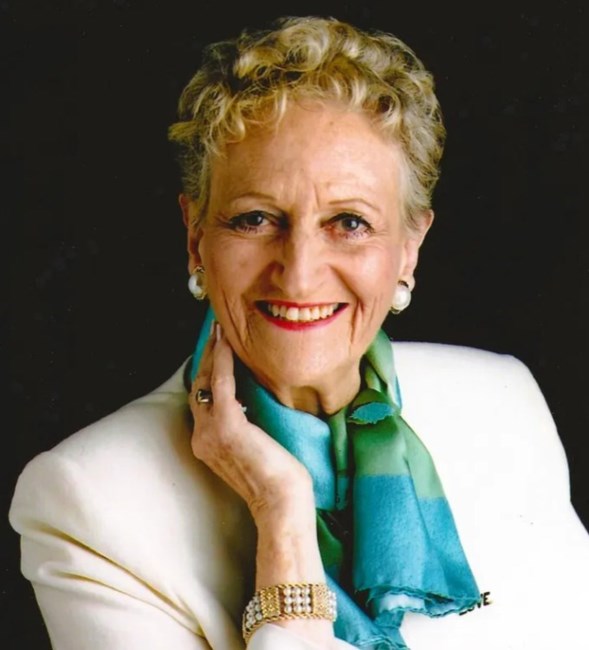
By Elizabeth Sobieski
Annette Green was my cousin.
In 1993, when FIT, the Fashion Institute of Technology, honored her at its gala, Annette Green danced a tango across New York’s Waldorf Astoria stage. It was, after all, the year of the tango dancing Al Pacino starrer, Scent of a Woman. Condé Nast’s then chairman, Lawrence Aiken, gave a speech, stating, “Green was responsible for turning fragrance into an international economic success.”
The New York Times once even described her as being “hyperosmic,” meaning someone with a heightened sense of smell.
Her olfactory sense was so enhanced that even at the age of 100, she could discern the difference between the scents of Contadina Tomato Juice and Sacramento Tomato Juice.
Aroma had always wafted its way through Green’s 102 years.
Given the sobriquet, “The High Priestess of the Fragrance World,” by the former president of Christian Dior Perfumes, she was the exalted head of The Fragrance Foundation for four decades, shepherding perfume from a niche market into a multi-billion-dollar industry.
She was born on April 26, 1924, in Philadelphia. Her mother, Mollie Green, a milliner, had traveled from her home in Atlantic City to shop in the City of Brotherly Love. Mollie, my great aunt, was at the perfume counter of Wanamaker’a Department Store when her amniotic sac broke, and her scent-loving daughter arrived at a Philadelphia hospital some hours later.
Annette was raised in Belleville, a small township neighboring Newark, New Jersey, considered the cherry blossom capital of America. Cherry blossoms have a delicate, sweet, vanilla fragrance.
During World War II, she was employed as an executive assistant in the New Jersey office of the Signal Corps. Later, she attended night classes at New York University’s School of Journalism while working as an editorial assistant for the Hearst publication American Druggist.
Her beat was covering the teen market, focusing on the beauty-and-fragrance category. This led to a job writing a newsletter for Richard Hudnut/DuBarry, then a New York-based beauty-and-fragrance company, which eventually became part of Pfizer.
A former colleague hired her as director of public relations for Lentheric Perfumes, a division of Squibb. Soon she was traveling to Paris and Grasse, learning the ways of French fragrance.
When Lentheric was acquired by Helene Curtis, it moved its headquarters to Chicago, and Green chose to remain in her beloved New York. She launched her own public relations company, Annette Green Associates, in 1960. Many of her clients came from the fragrance and cosmetics worlds.
In 1962, the failing Fragrance Foundation reached out to Green and her dedicated partner, the late Lois Berk, for help. The non-profit educational organization, which sought to foster and expand consumer appreciation and enjoyment of the fragrance experience in the United States, had been founded by six cosmetic and perfume houses in 1949, but was now on the verge of collapse.
Always feisty and willing to take on challenges, my cousin agreed to accept the role of director of The Fragrance Foundation. She later admitted that it took her ten years to bring the foundation back to life.
But what a life she gave it!
She scheduled seminars, bringing in speakers including scientists, psychologists, futurists — -even the legendary anthropologist Margaret Mead, who told The Fragrance Foundation, “You can never have a personal relationship with someone whose smell you don’t like.”
As president of The Fragrance Foundation, she spread the word that fragrance wasn’t for special occasions only, and that it wasn’t necessary to have a “signature scent,” that women could have a “wardrobe of fragrance,” any number of perfumes to be worn for different occasions and different times of the day and year.
Magazines and newspapers constantly consulted Annette Green and published her pithy quotes about trends in the fragrance field. Under her direction, educational programs were developed for schoolchildren nationwide and scientific studies to understand smell were funded.
Soon, new American fragrances, along with classic French perfumes, were breaking market records.
Green and The Fragrance Foundation encouraged women to buy fragrances for themselves, often less expensive colognes, rather than just obtaining perfumes gifted by men. And men were also being motivated to wear scent.
She started an annual luncheon highlighted by celebrity guest speakers, such as her favorite actress, Bette Davis, who became a dear friend.
Along with the established brands linked to fashion houses, by the 1970s and 1980s, some superstars, like Elizabeth Taylor, had become the faces behind popular scents. Others, like Cary Grant, Catherine Deneuve, and Sophia Loren, became associated with established fragrances.
Green came up with the idea of starting annual awards for her industry, with members of the foundation voting for such categories as the best new fragrance, the best packaging, the men’s fragrance of the year, the best bath line, and the best “nose” (master perfumer).
The Fragrance Foundation Awards, later dubbed The FiFi’s, brought out top celebrities and notable industry executives. Green wrote, directed, and produced every ceremony, from 1973 until 2003. They continue to be presented annually at Lincoln Center.
The success of the awards in the States led to adjunct international Fragrance Foundations, and additional FiFi Award presentations taking place in France, Germany, Italy, the UK, and Spain.
Under Green’s leadership, The Fragrance Foundation published an annual reference guide, featuring every company in the industry, along with the fragrances they created/distributed, whether they were members or not. Today’s membership includes over 100 fragrance companies.
She also established a monthly member newsletter, Fragrance Forum, which featured new fragrance launches, industry news, coverage of industry events and in-person interviews with major fashion designers who held fragrance licenses, such as Yves Saint Laurent, Paco Rabanne, Oscar de la Renta, Carolina Herrera and Donna Karan. She also interviewed Chanel’s master perfumer, Jacques Polge, at Coco Chanel’s atelier, 31 Rue Cambon, for the Forum.
Annette Green established an annual, highly publicized National Fragrance Week, working with various perfume houses, suppliers, retailers, magazines, and botanical gardens, celebrating fragrance and promoting its use worldwide.
She also created the Sense of Smell Institute, a nonprofit that awarded grants to neuropathologists and sensory psychologists at universities and hospitals around the world. She wrote, “A particular scent can make a person confident and productive while another can reduce stress and have a relaxing effect.”
She was disappointed to learn that this institute ceased operations a few years after her retirement.
Annette Green also spearheaded various traveling museum shows, including 1987–88’s “Scents of Time — Reflections of Fragrance and Society,” which opened at the Museum of the City of New York, later traveling around the country. The popular exhibit featured hundreds of bottles and related objects, such as aromatic jewelry and perfumed candles.
Green was the force behind the Fashion Institute of Technology’s (FIT’s) Cosmetics, Fragrance, and Toiletries program and its expansion into a bachelor’s degree and eventually, a master’s degree, focusing on marketing and global trade, along with educating students on the manufacture of fragrance and how flowers for perfume are cultivated and processed.
Also at FIT, she was able to launch a scent laboratory, the Annette Green/Fragrance Foundation Studio, which offers hands-on training in cosmetic and fragrance formulation.
And there now exists the Annette Green Fragrance Museum, open to the public at FIDM, The Fashion Institute for Design and Merchandising, in downtown Los Angeles, part of Arizona State University. The collection includes over a thousand vintage and contemporary bottles and boxes from over 165 international fragrance houses. It is the only perfume museum in the United States.
In 2002, Green received the Silver Medal of the City of Paris for her dedication to American and French friendship, after decades in which The Fragrance Foundation worked closely with the French Federation of Perfumery and Cosmetics.
After retiring in 2003, Annette Green continued to dwell in her elegant Gramercy Park apartment, traveling frequently, and engaging in all manner of cultural and philanthropic activities.
Until the onset of the pandemic, she was to be found traversing the city, wearing chic attire and her signature gold LOVE brooch, dining nightly at favorite restaurants or the National Arts Club, and attending theatre, opera, ballet, and museums on a quotidian basis.
I was fortunate to share many such outings with her.
Well into her tenth decade, Annette Green could be spotted racing her 1966 Mustang from the city to her summer beach home in East Quogue on Long Island.
At the age of 94, Green even published a memoir, Spritzing to Success, detailing her years in the fragrance industry and her lifelong love of travel and the arts. The master “nose,” Frank Voelkl, formulated a spicy but green fragrance, Annette’s Greenhouse, in her honor, and Leonard Lauder, the late chairman emeritus of Estee Lauder Companies, hosted a publication party.
In her memoir, she wrote, “To trade in perfume is to belong to romance.”
It may be romantic, but today the fragrance industry garners a global market worth roughly 62 billion dollars, with 2,000 new scents being introduced each year. In 1962, when Annette Green began her long leadership of The Fragrance Foundation, fragrance was a half-million-dollar industry.
An only child who never married, Green leaves behind no immediate family, but numerous devoted friends and several close cousins, including myself.
Show your support
Add a Memory
Share Obituary
Get Reminders
SHARE OBITUARYSHARE
- GET REMINDERS
v.1.18.0