OBITUARY
Xy Quang Nguyen
October 18, 1928 – January 3, 2015
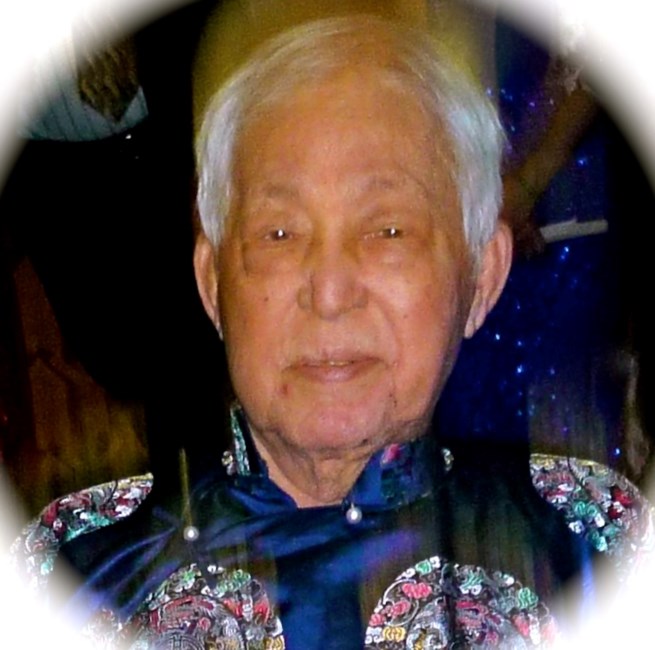
Dear friends, loved ones and family. My name is Le Thanh Phương Chinh, I am the only female grand daughter of my grand father, my mother is Nguỵet , and she is my grand father Nguyen Quang Xy’s first born daughter.
This is how I was, one-by-one, introduced to almost the entire town of Thai Binh, a small rural town in a Northern province of Vietnam, where my grandfather was born and raised. The townspeople of Thai Binh smiled as they spoke excitedly about Grandpa Xy. I learned that he was the first-born, and one of very few students bright and fortunate enough to attend school in those days. I learned that he was very handsome in his youth, and very smart. He rode his bicycle 7 km each way to school every day (yes, probably uphill, both ways). I learned that his marriage to my grandmother was arranged when he was 19 and she 21 that lasted 47 years until 1991 when she passed.
Growing up, my grandfather carried a bold and intimidating presence. But when it came to his grandchildren, there was always a gentle smile and his voice would soften. He was a constant presence in my life, no matter what was going on in his. There was always delicious Vietnamese food in his kitchen, or a large pot of pho on the stove, every time we showed up at his home. When I was young, before I knew any better, my grandfather was my barber, took me fishing and once, bought me very … sensible shoes. Each year during the moon festival, he hand-made us colorful cellophane animal lanterns; he taught me how to make kites from bamboo sticks, newspapers and rice paste; and many times I remember long sheets of parchment rolled out in his house as he carefully painted Chinese characters to hang on the walls. Even into my college years, if I bowed and greeted him properly in Vietnamese, there was always a little cash slipped into the palm of my hand.
Then there was his office, filled wall-to-wall of books, old Chinese wooden trinkets with red dangly tassels, half-written notes in Chinese with Vietnamese subtexts, and even the occasional quill and ink, or letter opener made of bone. I loved to stand in the shaded room, taking in the smell of dusty paper, menthol oil and yesterday’s burned incense. In my grandfather’s office, I observed the value of the written language. I learned to respect books. And I often wondered about the ways in which he could express the same idea, in so many different ways.
I had heard, that my grandfather was a talented scholar, a poet, a well-respected university professor, and a master of both the Chinese and Vietnamese languages. I had heard that just before he left Vietnam, he was driven and focused in his work: he had written a dictionary, translating the ancient characters of the Vietnamese language to the modern Roman phonetic alphabet that it is today. I had heard that “his home was always filled with monks, priests, teachers, and students discussing the latest books, the oldest poems, the most beloved novels, the pain of a country struggling for peace.”
Even with our language barrier that grew with every visit, I had a strong connection to my grandfather and to his life. I yearned to know what he knew. I had so many questions for him, which I did not know how to translate. He was right by my side at my college graduation. And later when I received my master’s degree, he humbly led me into his office and told me he could not think of a gift worthy of the pride he felt in my accomplishment. I was overwhelmed with love and respect. But before I knew it, he handed me the last autographed copy of his dictionary. A legacy to hold. A more than worthy gift, indeed.
This was the grandfather I knew, until the day we came to move him into his nursing home. Until the day we had to move all of his books into storage, divvy up the half-broken trinkets, and clean up his kitchen for the very last time. His presence was no longer bold or intimidating. I was honored to be able to be by his side.
I have been told, that my grandfather was a strong-willed, particular perfectionist. He was for sure, a dedicated and dutiful husband. For his children, he was a firm, critical, ever-present and loving father. For others, he was a proud and caring leader to his community, sharing and giving to others whenever he could.
I had heard, that he ran – twice – from war. Once, in 1955 the American Navy rescued them on the Operation Passage to Freedom, and then again in 1975, by helicopter. I had heard, that – twice – he got to start his life again, and each time to re-express the same idea in a different way.
Recently, my husband and I relocated ourselves and our children back to Vietnam, so we could learn the language and better understand our culture. After several months of studying Vietnamese, our then 7 year-old son, Sam, requested to have a Vietnamese name. Among several choices we suggested, Sam excitedly chose Quang Xy. I was glowing, proud that Sam had chosen his great grandfather’s namesake, to carry on the legacy of a passionate scholar, and a person of great character. And then Sam announced that he had chosen the name because it had both an X and a Q in it.
Dear Grandfather,
There is no longer a language barrier. I have looked up to you all my life, but you are no longer bold or intimidating. I am making my own cellophane animal lanterns these days. I love the written word in any language, and I am teaching my children how to respect a book. You may not cut my hair anymore, and I will never again wear any shoes you buy.
In my lifetime, I will not accomplish half the things you were able to even in the first half of your life. You left behind so many gifts. You left your legacy for the love of language, an example of passion, creativity, dedication, and achievement in your work. And you left the gift of family. You were so many things to so many people, in so many different lifetimes. We have never exchanged many words between us. So I will just say a brief thank you for being my role model, my hero – my X and my Q.
Show your support
Add a Memory
Share Obituary
Get Reminders
Services
SHARE OBITUARYSHARE
- GET REMINDERS
v.1.18.0